
117 search results for “gaan radio galaxies” in the Student website
-
 Gijs van Gaans
ICLON
-
 Onno van Gaans
Faculty of Science
-
 Huub Rottgering
Faculty of Science
-
Galaxies have bipolar gas outflows far into intergalactic space
For the first time, astronomers have observed in three dimensions that gas from spiral galaxies is blown upwards and downwards at high speed, far out of the galaxy. They thereby confirm the theory of galaxy evolution: that star-forming galaxies create intergalactic gas flows by discharging gas along…
-
 Marijn Franx
Faculty of Science
-
 Joshua Albert
Faculty of Science
-
Leiden researchers discover oxygen in the most distant known galaxy
Two teams of astronomers, including one from Leiden University, have discovered oxygen in the most distant known galaxy, JADES-GS-z14-0. This groundbreaking discovery shows that galaxies could form much faster in the early universe than was previously thought.
-
 Jurjen de Jong
Faculty of Science
-
Vici grant for research on the formation of galaxies
How do galaxies form? That is what astronomer Mariska Kriek will be researching in the coming years. She received an NWO Vici grant of 1.5 million euros to study galaxies in the early universe. ‘This research uses new and unprecedented observations from the James Webb Space Telescope (JWST). These allow…
-
Space oddity: Most distant rotating disc galaxy found
Researchers have discovered the most distant Milky-Way-like galaxy yet observed. Dubbed REBELS-25, this disc galaxy seems as orderly as present-day galaxies, but we see it as it was when the Universe was only 700 million years old. This is surprising since, according to our current understanding of…
-
Astronomers see birth cluster of galaxies in early universe
An international team of astronomers has discovered a large reservoir of hot gas in the cluster-in-formation around the Spiderweb Galaxy. Based partly on that hot gas, the astronomers predict that the cluster-in-formation will grow into one of the largest objects in the universe. A step closer to discovering…
-
Dust inhibits shock wave in iconic group of galaxies
The shock wave triggered by one of the five galaxies making up the iconic Stephan’s Quintet appears to be less disruptive than previously thought, with the shock likely being cushioned by dust particles in the surrounding gas. This is according to the analysis of the first scientific observations of…
-
PhD research Ivana van Leeuwen
Galaxies in the early universe contain more dust and hidden star formation than previously thought. That's what Ivana van Leeuwen concludes in her PhD research, where she combines data from various telescopes to create a more complete picture.
-
First photo of black hole at the heart of our Galaxy
Finally we know for sure that there is a black hole at the centre of our own galaxy. Today, astronomers unveiled the first ever photo of Sagittarius A*, a super-massive object at the centre of the Milky Way. This picture could only be taken thanks to the cooperation of telescopes worldwide.
-
 Anthony Brown
Faculty of Science
-
 Felix Smits
Faculty of Science
-
Dutch astronomers observe giant jets emanating from black hole
An international team of astronomers led by Dutch scientist Martijn Oei has discovered the largest pair of jets from a black hole ever seen. The 'jumbojets' extend a combined length of 140 Milky Ways. The Leiden Observatory played a prominent role in this research. The publication will feature on the…
-
Radio astronomers bypass disturbing Earth's atmosphere with new calibration technique
An international team of researchers led by astronomers from Leiden University (the Netherlands) has produced the first sharp radio maps of the universe at low frequencies. Thanks to a new calibration technique, they bypassed the disturbances of the Earth's ionosphere. They used the new method to study…
-
New generation galaxy formation simulations on the horizon – Evgenii Chaikin received his doctorate with honours
Simulations of galaxy formation provide much more information about galaxies than a telescope. Simulations have been improving significantly in recent years. Astronomer Evgenii Chaikin made such a significant contribution to this field that he graduated with honours on February 27th.
-
building blocks of life in ice around a forming star in neighboring galaxy
Astronomers have found complex organic ice outside the Milky Way for the first time. The discovery shows that the building blocks of life could arise early in the universe - and under a variety of conditions, said Leiden astronomer Will Rocha.
-
Hoe gaan we om met oplopende spanningen? ‘De keuze is: vechten of praten’
‘A Muslim and a Jew in the house of God.’ This is how historian Nadia Bouras introduced her recent conversation with colleague Sara Polak in Leiden’s Hooglandse Kerk. They discussed the rising tensions since the outbreak of the Israel-Hamas war. ‘Dare to ask each other questions.’
-
 Simon Portegies Zwart
Faculty of Science
-
 Bernhard Brandl
Faculty of Science
-
ACT-training: Accepteren kun je leren
Study support
-
Evidence of a massive stellar storm on a nearby star
Astronomer Joseph Callingham and his team have observed for the first time a clear signal from a giant burst from a star outside our solar system. This would have a devastating impact on any unfortunate planet orbiting the star.
-
Black holes are sometimes gigantic volcanoes. Martijn Oei earned his PhD on the subject, with honours
Not everything that comes close to a black hole is swallowed by it. Black holes can also hurl material away, and that chance turns out to be considerably bigger than previously thought. Martijn Oei's accidental discovery and his subsequent research on it earned him a cum laude promotion on 12 Decemb…
-
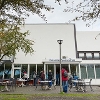 University Sports Centre
Goliuspad 22, Leiden
-
Compass on Purpose - Explore what matters to help you choose (NL/EN)
Career and apply for jobs, Study support, Study support
-
 Julia Folz
Faculty of Social and Behavioural Sciences
-
 Elena Rossi
Faculty of Science
-
 Martin van der Plas
Faculty of Science
-
After the launch of the next big space mission: ‘This is a big step towards understanding dark matter and dark energy.’
Henk Hoekstra and Alessandra Silvestri work on the astronomy and theoretical physics in the Euclid mission. These Dutch researchers are part of the mission.
-
The James Webb Telescope takes stunning photos. But what exactly are we looking at?
For over a year now, the James Webb Telescope has been sending stunning images that exceed astronomers’ expectations. The photos are fascinating to see, but what exactly are we looking at? Assistant professor Melissa McClure explains.
-
ESA presents first crystal-clear Euclid photos of the cosmos
The first full-colour images of the cosmos from ESA's space telescope Euclid were presented today. Never before has a telescope been able to take such crystal-clear astronomical images of such a large part of the sky and so far into the deep universe. The five images illustrate Euclid's full potential;…
-
First scientific images Euclid telescope exceed all expectations
Space telescope Euclid is capable of unravelling the secrets of the universe. That is what the images published by ESA today show, according to astronomers working with the telescope's data. The images exceed all expectations. Scientists within the Euclid consortium, including astronomers Henk Hoekstra…
-
Accidental double zoom reveals millimetre waves around supermassive black hole
An international team of astronomers led by Matus Rybak (Leiden University) has proven, thanks to accidental double zoom, that millimetre radiation is generated close to the core of a supermassive black hole. Their findings have been accepted for publication in the journal Astronomy & Astrophysics.
-
Space telescope Euclid makes first test images - astronomers are full of anticipation
The two instruments of ESA's space telescope Euclid have taken their first test images. The first images indicate that the space telescope will achieve the scientific goals for which it was designed - and possibly much more. Euclid will create a 3D map of a third of the sky, allowing scientists to study…
-
Astronomers Discover Ancient Solitary Quasars with Mysterious Origins
An international team of astronomers, including Leiden PhD student Elia Pizzati, has observed several ancient quasars that, surprisingly, appear to be floating alone in the early universe (less than a billion years after the Big Bang). Until now, astronomers, based on models, assumed that quasars are…
-
Four Vici grants for Leiden University researchers
Four researchers from Leiden University have been awarded prestigious Vici grants the Dutch Research Council (NWO) has announced. The honoured applications are from researchers at the Faculty of Social and Behavioural Sciences, Leiden Observatory, the LUMC and the Faculty of Archaeology.
-
FLAMINGO: dark matter, ordinary matter, and neutrinos in the biggest cosmological simulation ever
Not only dark matter, but also ordinary matter and dark energy are tracked in the largest ever cosmological computer simulation ever. In the FLAMINGO simulations, you can see virtual galaxies and clusters of galaxies emerging over the course of billions of years. This is no easy task: with more than…
-
Euclid helps to better understand the universe – first results are exciting
For the first time, we’re seeing what Euclid sees. The telescope’s initial observations have provided a wealth of new information about our universe. But according to cosmologist Alessandra Silvestri, this is just the beginning. The research helps us gain a deeper understanding of the past, present,…
-
Last starlight for space telescope Gaia
ESA’s space telescope Gaia, which maps the Milky Way, completes its active phase of scanning the sky on 15 January. Over the past decade, Gaia has made more than three trillion observations of about two billion stars and other cosmic objects. ‘Gaia is already the discovery machine of the decade,’ Leiden…
-
Maarten Schrama elected Teacher of the Year 2021
Maarten Schrama (CML) has won the Teacher of the Year Award 2021. During a lunch with fellow nominees, Schrama received a cheque worth 5,000 euros from student assessor Joost Barendse to spend on educational activities.
-
Supermassive black holes: how do you study something that is invisible?
How are supermassive black holes born? That is the question astronomer Elena Maria Rossi is trying to answer. But how do you investigate something you cannot see?
-
White dwarf with partner flashes every two hours
An international team of astronomers has shown that a white dwarf and a red dwarf orbiting each other every two hours are emitting radio pulses. Through the discovery, astronomers now know that the monopoly on bright radio bursts is not solely held by neutron stars. The team of international scientists…
-
Black hole one year later: proof of a persistent shadow
The brightness peak of the ring around M87's supermassive black hole has shifted 30 degrees counterclockwise in a year. This is shown by new images released by the Event Horizon Telescope consortium.
-
Mesmerising images from James Webb space telescope
The 'deepest and sharpest' image of the Universe to date: the first photos from the new James Webb space telescope yesterday mesmerised astronomers and the public alike. Leiden Professor of Molecular Astrophysics, Ewine van Dishoeck, spoke to various media outlets about the first images, which include…
-
In extremis: five extremes in 450 years of Leiden research
By looking at what is different, researchers often discover the special, the unusual. And that has already brought a wealth of highlights – also in Leiden.
-
Safety instructions
The university finds it important that students and staff are offered a safe environment. Read here about the safety measures in place and what you should do in case of emergencies or other incidents.
-
Career Prep: Panel session and Meet & greet with alumni (for CADS students)
Career and apply for jobs