
Debate
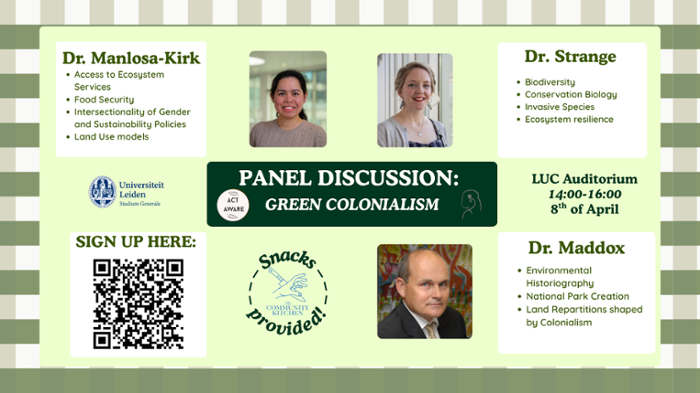
Panel discussion: Green Colonialism
- Date
- Wednesday 8 April 2026
- Time
- Address
-
Anna van Buerenplein
Anna van Buerenplein 301
2595 DG The Hague - Room
- 2.21
Who pays the price for “going green”? Join Aisa Manlosa, Emily Strange, and Gregory Maddox for a discussion of green colonialism. They will cover natural park creation, conservation practices, livelihoods based on land use, and the history of it all.
“Green colonialism” refers to environmental projects led by outside powers in regions that were once colonised. While these initiatives are often presented as efforts to protect nature, they can take land away from local communities, increase poverty, and weaken traditional ways of life. In many cases, Indigenous voices are ignored, even though they are most connected to the land and most affected by changes to it.
A clear example can be found in conservation projects on the African continent led by international organisations. During colonial times, local populations were forced off their land to create hunting grounds for the European elite. After independence, these areas became nature reserves, but because international organisations often managed them while sidelining Indigenous knowledge and decision-making, these practices effectively continued colonial control under the guise of nature conservation, as seen in models such as land sparring. The effects of green colonialism were often disastrous, as these projects further disrupted ecosystems and placed additional pressure on the wildlife they claimed to protect.
Green colonialism is also present in food systems, the livelihoods that depend on those, and different land practices that displace communities and restrict their access to land and resources. These practices continue today, but awareness of their harmful impacts is growing. Grassroots initiatives are challenging green colonialism by promoting local decision-making, community-led conservation, and ways of managing land that respect both people and the environment.
How can local communities regain control over their land and resources? How do we prevent environmental projects from serving Western goals instead of local needs? How do we hold international organisations and companies accountable for the social and environmental impacts of their past and current projects? In short: how do we reverse green colonialism?
About the speakers
Dr. Maddox is a professor at Texas Southern University and will be joining to discuss environmental historiography, particularly in Tanzania. This is linked to the creation of national parks and land repartitions that were shaped by colonial ideals. These are discussed in works such as “Networks and Frontiers in Colonial Tanzania”, Custodians of the Land: Ecology and Culture in the History of Tanzania and “Africa and Environmental History.”
Dr. Manlosa-Kirk is an assistant professor at Leiden University College who specializes in Sustainable livelihoods, food security, and gender and equity. Her works are on access to ecosystem services and different land use models for combining conservation and food security as well as interactions between gender and sustainability policies. These topics would bring more of a social and holistic perspective to combine ecocentric and anthropogenic needs in resource use. The following works “Ecosystem services from forest and farmland: Present and past access separates beneficiaries in rural Ethiopia” and “A social-ecological assessment of food security and biodiversity conservation in Ethiopia” delve deeper into these explorations with quantitative and qualitative evidence.
Dr. Strange is a professor at Leiden University working and teaching in the areas of biodiversity, conservation Biology, invasive Species, plant communities, and ecosystem resilience. As a guest lecturer in LUC’s Conservation Biology course, she brought in interesting perspectives on species-specific biocontrol and how it's viewed in most ‘western’ science as opposed to countries such as South Africa. This connects to her work on “Invasive Alien Aquatic Plants in South African Freshwater Ecosystems”. Additionally, she has also published work on the Ngorongoro protected area, the issues of its land sparring model, and how it's an obstacle to sustainable agriculture, see “A learning network approach to resolve conservation challenges in the Ngorongoro Conservation Area”.