Lecture | YAL & Studium Generale
Time Talks: Temporality Across Disciplines
- Date
- Wednesday 20 May 2026
- Time
- Explanation
- Please sign up below
- Address
-
Spui Campus
Spui 5
2511 BL The Hague - Room
- 1B.12
What does time mean in the study of language, the past, and the universe?
When was the last time you stared out of your window and took the time to let your mind wander? According to the popular philosopher Byung-Chul Han, time nowadays whizzes by, and every moment needs to be filled with productivity. In today’s fast-paced world, we are often unable to confront long-term challenges such as the climate crisis or economic instability. These issues seem so vast and span such long periods that they become difficult to grasp.
It might be time to step back and reflect on the concept of time and temporality itself. What does our orientation toward and conception of time tell us?
Temporality plays a role in every academic discipline, from the timespan of the universe to the study of archaeological traces of the past. Members of the Young Academy Leiden will give short talks on the role of temporality in their research in astronomy, archeology, and art history. The event will conclude with a panel discussion, moderated by YAL-member dr. Anne Urai.
How do people from various cultures and historical periods perceive and articulate temporality? What are the overlaps between the study of time in astronomy, linguistics, archeology, and art history? And what can these insights teach us about our own sense of time?

The Talks
Dr. Marcel van Daalen - Astronomy
In astronomy and cosmology, we concern ourselves with timescales of many millions to billions of years. In this talk, we compare the time scale of the age of the Universe to historical events on Earth, consider how our solar system will evolve over the next few billion years, and our Universe as a whole over the next tens of billions of years.
Dr. Arjan Louwen - Archeology
In archeology, time is a pivotal concept. It can be approached from many different angles: from old-fashioned typo-chronological schemes (think of how pottery changes over time) to estimate when something was made, to radiocarbon dating. And from reconstructing how people in the past experienced transitions or important moments in life, to time-pressure in commercial archeological field projects. However, the biggest challenge archaeologists face when time is of the essence, is resolution: how much time was involved in something that happened in the past? How long did events take, how quickly did changes happen? How do we begin to grasp that certain amount of time?
Dr. Lieke Smits - Art History
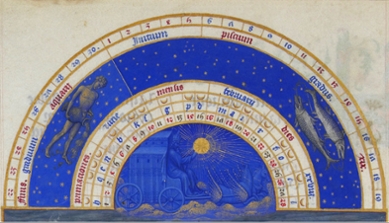
How did people in the late medieval Low Countries structure their days? Time was increasingly measured and monetized. The bestselling book of the period, however, the Book of Hours, promoted time for prayer and contemplation throughout the day. In this talk, we will see how different notions of time existed next to each other and how medieval temporalities inspire present-day philosophers and artists.
This English spoken event is part of the Young Academy Leiden’s Season of Interdisciplinarity: Spring of Time and is a collaboration between YAL and Studium Generale.