Conference | LDE GMD Annual Conference 2026
Design and Migration Societies: Co-creating Just Futures
- Date
- Tuesday 3 November 2026
- Time
- Serie
- Leiden Interdisciplinary Migration Seminars 2026-2027
- Address
- TU Delft, Faculty of Industrial Design Engineering
Migration has grown into one of the most controversial and polarising issues of our time. This reality is evident across many policy practices and societal domains: from shelter, reception and housing to education, employment, healthcare, security, and culture. Many professionals are confronted with its complexities, opportunities, and dilemmas. Yet, in public debate, migration is often reduced to an issue in its own right, separate from other societal challenges. This can obscure a clear understanding of the causes and consequences of migration, and can push the interplay between migration and, for example, the housing crisis and labour market exploitation into the background.
Migration is commonly studied from the perspectives of public administration, (inter)national law and security, history, economy and development studies. However, a design perspective is often missing from the debate. This conference will explore and showcase what design, as an interdisciplinary way of thinking and practice, can offer to our understanding of the governance of migration, diversity, and inequality, and particularly to co-creating just futures and societies.
Selected panels
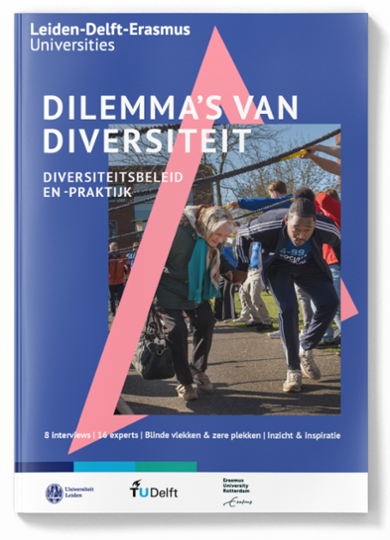
Launch of DIDI White Paper: Dilemmas of Diversity — Diversity Policy and Practice
Organiser: Prof. Marlou Schrover (Leiden University, History)
Panellists: Kay Mars (Erasmus University Rotterdam, Sociology); Suzan Abozyid ( Leiden University, History); Lieke van der Veer (TU Delft); Thérese Nleng (NOOM — Netwerk van Organisaties van Oudere Migranten); Carla Delgado Swiatkowski (Landelijk Samenwerkingsverband Actieve bewoners); Raphaël Boon (Gemeente Leiden, Projectleider diversiteit, inclusie en gelijkwaardigheid); and others.
The white paper Dilemmas of Diversity — Diversity Policy and Practice contains eight dialogues between sixteen experts from academia, government and civil society organisations on current issues. The publication is intended for policymakers, administrators, professionals and anyone working to promote inclusive public services and social participation.
The panellists will present short pitches related to the white paper and the key theme of the conference. For designing future policies, we need an organisational infrastructure that goes beyond simply including a handful of co-designers. Policies are and have been designed (including for housing) without taking stock of which "problems" they sought to solve. Municipal authorities have decades of experience building these infrastructures. Historians analyse how design on paper — regarding housing, regarding integration policies, regarding social cohesion — has worked out in practice and how knowledge infrastructures that have been built up over the years can fall apart within a short period. "Neutral" design labels turn into negative stereotypes overnight. Thinking about "just futures" also has to do with how authorities deal with low-level complaints (about badly designed public spaces and street lighting). Ambitious plans to design spaces that can include "everybody" fail to acknowledge how hard it is to change power structures that go back decades.
Designing the Future of Migration Studies in the Netherlands
Designing the Future of Migration Studies in the Netherlands
Organisers: Ilse van Liempt (Utrecht University), Nadia Bouras (Leiden University) and Peter Scholten (Erasmus University Rotterdam)
Participants: Monique Kremer (Adviesraad Migratie); Maite Vermeulen (De Correspondent); Nawal Mustapha (University of Amsterdam); Leo Lucassen (International Institute of Social History); Marlou Schrover (Leiden University); Rinus Penninx (University of Amsterdam); Han Entzinger (Erasmus University Rotterdam); Saskia Bonjour (University of Amsterdam); Halleh Gorashi (Vrije Universiteit Amsterdam); and others.
Fifty years of migration research in the Netherlands — what have we learned, and how do we design the future of the field? This workshop brings together a broad group of leading migration scholars from across the Netherlands to reflect on knowledge production, the politicisation of migration research, and the evolving relationship between science, policy and society. The session is linked to a collaborative book project.
The workshop explicitly explores what it means to design the future of migration research in a way that combines scientific excellence with societal impact. Participants will consider how migration research in the Netherlands has developed over five decades, how the field navigates an increasingly polarised public and political landscape, and what new directions are needed for the years ahead.
Designing a Displacement-Sensitive Climate Vulnerability Framework
Designing a Displacement-Sensitive Climate Vulnerability Framework
Organisers: Carolien Jacobs (Leiden University, Van Vollenhoven Institute) and Sonja Fransen (ISS, Erasmus University Rotterdam)
An interactive workshop on climate vulnerability, displacement and humanitarian governance. Participants co-design assessment frameworks that account for the specific risks faced by refugees and internally displaced persons in the context of climate change and climate adaptation. The workshop brings together legal, social-scientific and design perspectives to explore how vulnerability frameworks can be made more sensitive to the realities of forced displacement.
Design and Migration: A Transdisciplinary Dialogue to Challenge Methodological Blindspots
Design and Migration: A Transdisciplinary Dialogue to Challenge Methodological Blindspots
Organisers: Alessandra Bernardi and Deger Ozkaramanli (TU Delft, Faculty of Industrial Design Engineering), Moritz Jesse (Leiden University); Matthijs van Dijk (Reframing Studio, co-organiser); Medha Gupta (GMD Alumni, Chair of Student board)
Migration is one of the major societal transformations of our time, involving multiple societal and public domains and often addressed through polarised, politicised frames. Design has expanded into policymaking, contributing exploratory and human-centred approaches to complex challenges; however, design methodologies are not neutral: they are shaped by positionalities, biases, values, and external limits such as the legal system.
This workshop argues that one way to reveal methodological blind-spots and move beyond assumptions of neutrality is by bringing design and transdisciplinary processes into conversation. Using a 3x3 futures matrix developed in a TU Delft IDE master's graduation project as a boundary object, participants will critically reflect on the narratives around migration it proposes and the positionalities, values, and biases underpinning methodological choices, aiming for an open inter- and transdisciplinary critique and further development.
Shapes of a Future-proof Labour Migration System in the Netherlands: A Policy Lab with the IND
Shapes of a Future-proof Labour Migration System in the Netherlands: A Policy Lab with the IND
Organiser: Michiel Swinkels and Diana Stefanescu (Immigration and Naturalisation Service, Strategy and Policy Unit)
Participants: Olaf van Vliet (Leiden University, confirmed); Tesseltje de Lange and Judith van Uden (Radboud University, Centre for Migration Research)
The Netherlands is entering a period in which demographic change, economic transformation, and geopolitical uncertainty are reshaping the future of work. Labour shortages are becoming more persistent across sectors, while the transition to a more sustainable, digital, and resilient economy is creating a demand for new skills and talent. One of the paths considered for creating and attracting such talent, is through labour migration from countries outside of the EU. Migration, however, remains a topic that requires careful consideration of economic needs, social cohesion, and workers’ rights. Within this context, an important question arises as to how a future-proof labour migration system may – practically - look like in The Netherlands. And subsequently, what is needed from different stakeholders shaping the labour migration system of the future?
The IND has a unique position in the current Dutch system as the authority which processes all applications for (combined) residence and work permits, working closely with other public service providers to assess whether an individual’s professional stay serves a substantial Dutch interest. As such, the IND wishes to be prepared for the future and is therefore exploring what a future-proof labour migration system might look like in light of the new Dutch talent strategy published in July 2026, and the current cabinet’s plans for a piloting a skilled worker scheme. With the help of conference participants we want to think about new procedures that contribute to IND’s mission. Throughout the session, participants will be presented with policy and implementation dilemma’s, identify opportunities and challenges, and discuss labour migration measures and implementation requirements that balance flexibility with predictability, and identify what is needed from different stakeholders to accommodate this.
Visit the conference website for programme and registration
Conference website