
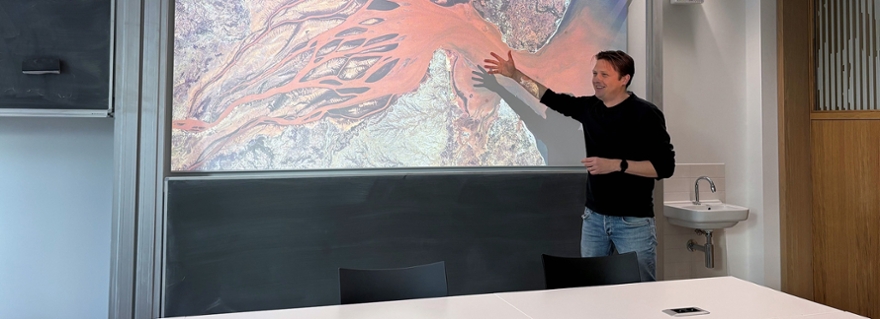
‘Teaching is like a professional sport: you always have to be switched on’
For a long time, Thijs Bosker was an average student, until he discovered how exciting learning becomes when there are no ready-made answers. To his students, he passes on one key message: hope is the driving force that keeps us moving forward. They nominated him as Lecturer of the Year.

What kind of student were you yourself?
‘I was, for a long time, very much an average student. A pass was a pass, and that was good enough for me. That changed when education became less about memorising facts and more about thinking for yourself. That’s when I switched on. Once there was no ready-made answer and I had to reason things out and make my own choices, learning suddenly became genuinely interesting.’
What’s the most important lesson you want your students to take away?
‘I mainly want my students to understand that hope always has value. Not the naïve kind of optimism, but the kind Jane Goodall often spoke about, something that fuels you to keep going, even when the outlook seems bleak.
That’s especially important in environmental studies, because many students (and lecturers) struggle to see solutions amid all the bad news that comes their way. In those moments, hope keeps us moving. It makes us keep searching and trying. That’s what I want my students to remember.’
If you had to choose: research or teaching?
‘Luckily, I don’t have to choose! In my work, research and teaching are closely intertwined. I do a lot of research-led teaching, where I use my own research in class or let students conduct their own studies. But there’s also teaching-led research, where a classroom project leads to new insights and research questions. For me, the two constantly strengthen one another.’
‘Standing together around a campfire at the end of a field course: those are memorable moments.’
What has been a special teaching moment for you?
‘The field courses I’ve developed, in Africa and on the Wadden Islands, are truly special to me. You spend an extended period with a group of students, learning together, observing the environment, and having great conversations. Often not just about science, but about life in general. Standing together around a campfire at the end of a field course: those are memorable moments.’
What do you do when you get a question you can’t answer?
‘That depends on the question. If it’s something small or factual, I’ll ask students to look it up themselves and share it with the group. But in my field, we simply don’t have answers to many questions. How do we solve climate change? How do we prevent polarisation in environmental debates? Those are the very questions at the heart of my teaching. There are no simple answers, so we explore them together.’
Do you ever still get nervous before a lecture?
‘Haha, absolutely! Especially at the start of a new course or when I walk into a big lecture hall with two hundred students, I definitely feel the adrenaline. Right before that, I often listen to Eye of the Tiger. For me, teaching is like a professional sport: you have to be completely switched on. And a bit of upbeat music helps get me in that energy.’
About Thijs Bosker
Education: Science for Sustainable Societies (SfSS) and the BSc and MSc Biology programmes
Teaching: Currently teaches Intro to Science for Sustainable Societies and Integrated Field Methods (both SfSS), as well as Environmental Biology 2 and Ecotoxicology (Biology). He is also programme director of the new Bachelor Science for Sustainable Societies.
Research: Bosker studies how different forms of pollution – from light and noise disturbance to microplastics – affect the health and functioning of organisms, ranging from plants and invertebrates to fish and whales.
Other: He runs two websites designed to help educators integrate environmental issues into their teaching:
Unplastic.education supports secondary school teachers who want to incorporate environmental issues, especially plastic pollution, in their lessons. It provides teaching materials, workshops and activities that showcase sustainable alternatives.
Local-actions.com helps university lecturers link environmental issues to disciplines such as psychology, international law and communication studies, making it easier to incorporate sustainability into their teaching.