
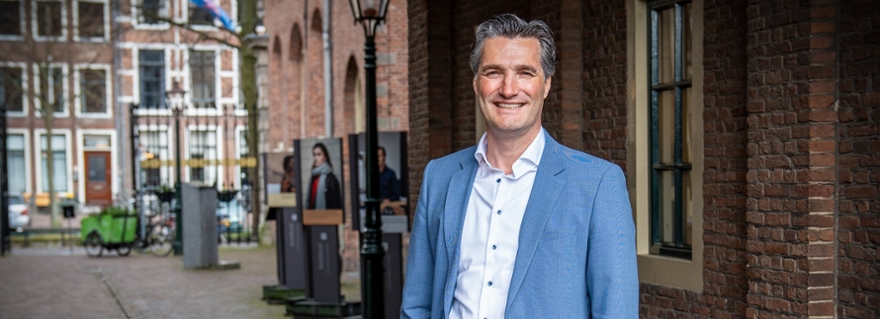
Timo Kos: ‘We want our buildings to be as open and safe as possible’
Speaking for the Executive Board, Timo Kos reflects on the university’s security policy and what lies ahead. ‘We want to keep our buildings open, but we also need to be able to guarantee the safety of everyone there. It’s a real balancing act.’
The closure of the Wijnhaven building in 2023 and the resulting security measures there caused prolonged inconvenience for students and staff. How do you view that?
‘As the Board, we’re responsible for ensuring that all our students, staff and visitors – tens of thousands of people every day – can study and work safely on our campuses in Leiden and The Hague. We have around 50 buildings at different locations, each with its own challenges. At the same time, we want and aim to keep our campuses as open as possible and to be transparent about why we take security measures when we consider them necessary. Full transparency isn’t possible because this could compromise people’s safety. This responsibility and this dilemma weigh heavily on me and my fellow board members. If there are real threats or security risks, we won’t hesitate to implement the security measures we deem necessary.
‘We live in a time when more and more people – politicians, judges and journalists – are facing threats, sometimes short-term and sometimes for longer. And researchers are increasingly among those under serious threat. This has a profound impact on their lives and on their loved ones. As an employer, this places a huge responsibility on us to ensure these colleagues can work freely on our campus while also guaranteeing the safety of all other students and staff.
‘The National Coordinator for Counterterrorism and Security (NCTV) is responsible for the most heavily protected people in the Netherlands, and universities liaise with them if such security risks arise here. I can’t comment on the extent to which that applies to us.
‘That said, I do think we can communicate better about the measures we take. In recent years, we haven’t always succeeded in explaining clearly to the wider academic community why measures are sometimes necessary, how we weigh them carefully and how we scale them up and down. I hope the new security policy will improve this.’
Can you give a concrete example of this security policy and how security could have been handled differently?
‘We’ve recently taken steps to improve the balance between security and accessibility. We were pleased that NATO boss Mark Rutte was able to visit Wijnhaven in September to talk with over 800 students and staff. Additional security measures were needed to ensure his safety and that of everyone present. At the same time, a demonstration was allowed to take place in the building. This did cause some inconvenience, and not everyone was happy about it, but I think it was a positive development that we chose to allow it – taking into account both the importance of safety and the right to demonstrate. And our colleagues from the Security Affairs team and the University Services Department deserve credit for making sure the afternoon ran smoothly.’
If we look at the decision to close Wijnhaven on 12 October 2023 and to implement extra security measures after, freedom of information documents suggest it was a visitor mistakenly thinking they were at the Immigration and Naturalisation Service (IND). Why didn’t the Executive Board scale back the security measures sooner?
‘Decisions like temporarily closing a building – aimed at ensuring people’s safety – are made after weighing information from various sources, such as the police and other services, along with the context and dilemmas involved.
‘At that point, the situation was unclear, but it was consistent with a long-standing, significant threat level specific to our university. We live in a society where threats are increasingly common – including for researchers, as I mentioned earlier. In The Hague, we also face the special circumstance that our buildings are in the city centre, where many people live and work, in the heart of our domestic government, with embassies around the corner and ministries just steps away. The security risks here were, and still are, clearly different from those at other buildings.
‘The decision to close the building must be seen in that context. It was based on the information available at the time, including intelligence from the services. I can’t and won’t share the details, precisely because we need to protect our people. I know: it’s a real Catch-22. To be fully accountable – and I want that as much as possible – I’d have to share all the information. But doing so would make our future less secure. That is and remains a dilemma.
‘For us, the main priority is that everyone can visit, work and study safely in our buildings. That’s always the focus of any measures, and it’s what I stand for as a board member.’
How will security risks be assessed from now on, and by whom? And how will the Executive Board make sure similar mistakes don’t happen again?
‘We’ve set up the Security Measures Steering Committee, which we asked to review the security measures for the buildings on Campus The Hague. Based on their findings, we’re making some changes. This approach is part of our revised security policy, which also provides for regular reviews of all our buildings. Using current information about security risks in our sector and specific risk assessments for these locations, the proposal is to scale back some measures.’
Looking back, did staff or administrators make mistakes in 2023 and after?
‘As a board member, like my predecessors, I’m responsible for the safety of everyone on our campuses and am accountable for that. I can see that we haven’t succeeded in explaining why certain measures were necessary. That’s why we’re revising our security policy and carrying out regular risk analyses to assess threat levels, using all available internal and external information. We’ve documented these steps and procedures in our security policy to ensure clarity and consistency. This will make us as transparent as possible and allow everyone to hold us accountable. But we can’t always share everything we know, precisely because of security concerns.’
What are your hopes for the future?
‘Through our updated security policy, we aim to provide clarity and explain the difficult choices we face in balancing the openness and accessibility of our buildings with the security needed to keep our students, staff and visitors safe. My hope is that we can keep our buildings as open as possible, ensure everyone can work and study safely, and continue to welcome visitors, whoever they may be.’