A platform for a complex conflict: ‘Friction is good’
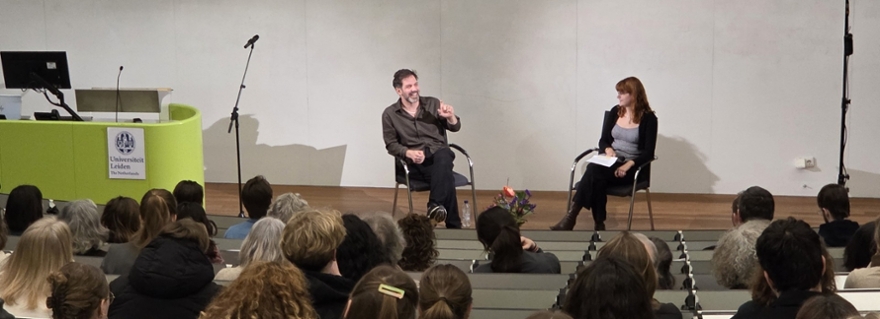
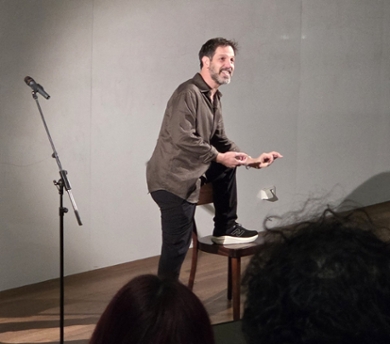
Yousef Sweid was called a ‘stinking Arab’ in the sandpit at his Jewish kindergarten in Haifa. In a packed lecture hall, the Palestinian-Israeli actor performed a powerful excerpt from his show ‘Between the River and the Sea’.
The event on 16 February marked the launch of the second season of theRadio Palestine/Israel podcast, an initiative by Noa Schonmann, Assistant Professor of International Relations of the Middle East, and Rajaa Natour, a journalist.
Thirty master’s students are taking the Radio Palestine/Israel: Voices in Conflict course. They learn to ask difficult questions without having to take a stance, and ask these questions to journalists, activists and experts on the Israel-Palestine conflict. They’re not expected to pick sides, and their personal opinions may differ from those of their interviewees. ‘That can be hard, uncomfortable and cause friction. And that’s precisely the point. That’s what life is,’ says Schonmann.
Complex life story
That is the crux of Sweid’s frank and darkly humorous account of his complex life – a life lived between languages, cultures and competing historical narratives. With two Jewish ex-wives and a son and daughter who are growing up in the safety of Berlin, where the actor now lives as well.
Known for series including Homeland, Game of Thrones and Unorthodox, Sweid is currently touring Europe with Between the River and the Sea. He performed part of the piece in the Lipsius building on Monday 16 February. A discussion with the audience followed.
He didn’t hesitate when Schonmann and her students invited him to come to Leiden. ‘I think it’s amazing that these students are learning from the Israel-Palestine conflict. It’s unique, which is why I’m so glad to share my story here,’ he says afterwards.
Debate and understanding
Henk te Velde, Dean of the Faculty of Humanities and an enthusiastic member of the audience, agrees. ‘This is what we as a university are for: confronting each other with difficult contradictions in an incredibly complex conflict. Having debates and seeking understanding rather than shouting our opinions. What Noa and her students are doing sets an example for all of us. It offers hope that we can move forward together. In the course and in the podcast, she’s found an approach that really works.’
Bitter reality
Schonmann is Israeli and Natour is Palestinian. ‘We’re emotionally connected and affected by the conflict,’ says Schonmann. ‘We started this course and the podcast because we had no other choice. We had to act. We saw the lives and careers of people around us changing. What could we do to make sense of it all? I’m glad we’ve found this method for our students. You learn this from the real world, not from books. This is life. The bitter reality.’
Dialogue
Student Valérie Krah chose the course for the combination of politics and journalism. She has learned a great deal. ‘Sometimes you need to put your own opinion on the back burner. Listen to the other and then have a dialogue, but in a professional way. We’ve had many discussions about how to handle difficult narratives that clash with your own beliefs. And I’ve learned more about the conflict itself.’
Space for emotions
The classes were intense at times, says student Josha Kanne. ‘There was space for emotions, which I think is important. There’s so much suffering, and real human lives are at stake. It’s fascinating to learn more about the history of the conflict as well as new skills like interviewing and editing. We’ve found some great voices for the new podcast season. I hope everyone will listen.’
The Radio Palestine/Israel can be found on various podcast platforms: