
Discussing the role of AI in education: ‘We need a shared vision’
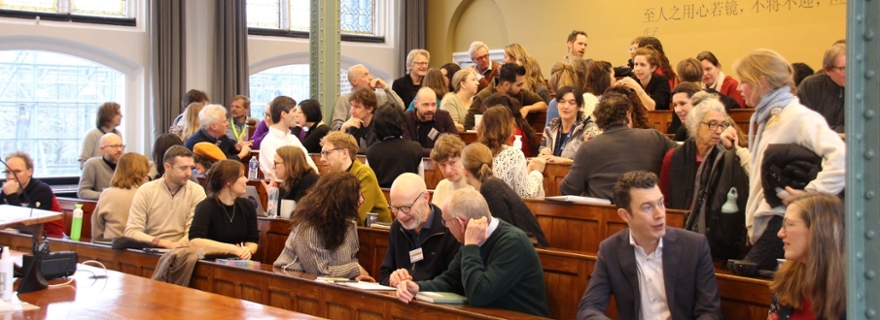
How do you ensure that students still learn anything when they can have AI write an entire thesis in a matter of minutes? Staff members from the Faculty of Humanities discussed this and other questions during a special AI symposium. ‘Writing and independent thinking are crucial, especially in our field.’
There appears to be a great need within the faculty for more guidance on how to deal with generative AI. Already during the opening, questions are flying thick and fast in the packed lecture hall. How do you make exams AI-proof? How do you deal with students who have probably used AI improperly but are unwilling to admit it? And, more fundamentally, should there be any place at all for generative AI at university?
Professor Bas Haring, who supervised a master's thesis using AI last year, can therefore expect many questions during his keynote speech. The difference between the humanities and the more empirically oriented sciences is particularly striking. In research based on experiments, reporting can perhaps be done largely by AI, as Haring suggests, but in the humanities, writing is sometimes the most important part of the research. Outsourcing this may mean losing the core of the discipline.
Need for guidelines
Various working groups are therefore continuing to discuss the specific role of AI in the humanities. What is its impact on examinations, how can you use it yourself, and what is the student perspective on the new possibilities? Although the general consensus may sometimes be that students would prefer to outsource their assignments, it quickly becomes apparent during the session that they too are struggling with all the new possibilities that have been presented to them. There is a great need for guidelines on how to use it correctly.
‘Explore alternatives’
During the subsequent poster presentation, several of these correct applications are on display. For example, several tutoring bots have recently been built on the LUCA platform, which allow students to practise or have their questions answered.
Vice-Dean Jeroen Touwen encourages this experimental approach. In response to the question about “a vision and guidelines” in the closing discussion, he says: 'We do not yet have an overview of all the alternatives. I am sure there are people here in this room who would prefer to lock the doors to their lecture halls and shut down the internet, while others want to use the new resources. We will have to explore all these alternatives together to find out what works best.'