
DNA study reveals remarkable stability in prehistoric Low Countries populations
For thousands of years, the prehistoric communities of the Low Countries followed their own path compared with the rest of Europe. This unique region later played a key role in major European shifts. An international research team has now published these findings in Nature.
While large-scale migrations and rapid genetic changes occurred elsewhere in Europe, the population of what is now the Netherlands, Belgium and north-western Germany remained remarkably stable. The study shows that Europe’s prehistory was far less uniform than often assumed. According to the researchers, landscape, lifestyle and social structures proved decisive. The results were published in Nature on 11 February.
Farming arrived later
The findings are noteworthy because hunter-gatherers and early farmers in other parts of Europe intermixed on a large scale much earlier, explains archaeologist Quentin Bourgeois. This took place between 8500 and 4000 BC, and within just a few centuries, farming ancestry became dominant across much of Europe. According to the study, however, hunter-gatherer DNA remained predominant in the Low Countries until around 3000 bc.
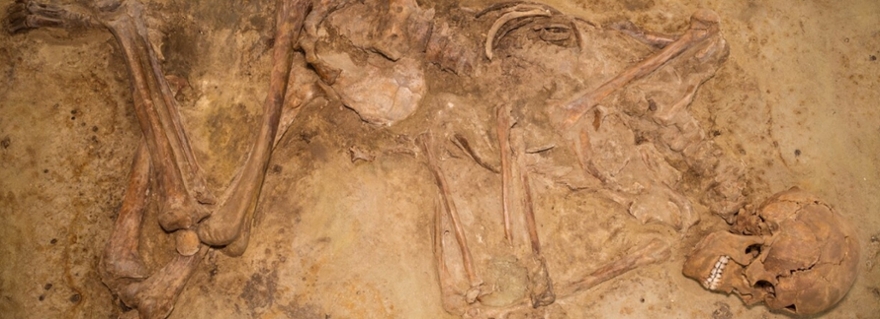
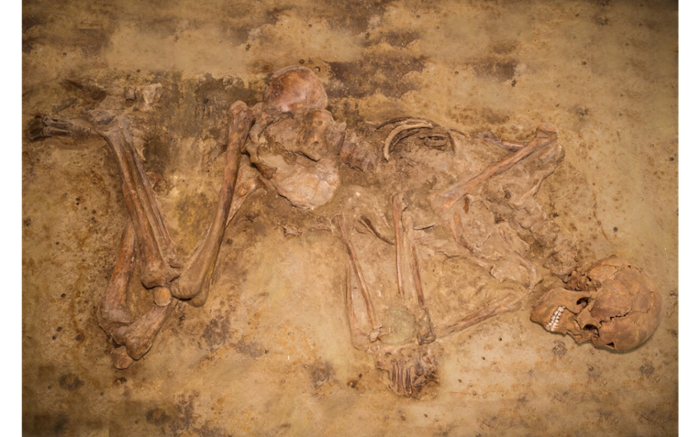
The international team analysed skeletal remains from 112 individuals dating from 10,500 to 3,700 years ago. These individuals lived in the Rhine–Meuse region of the Low Countries – today’s Netherlands, Belgium and north‑western Germany.
‘Previous archaeological research had already shown that large-scale farming emerged later in the Low Countries. Our genetic research aligns perfectly with the archaeological evidence,’ says Bourgeois.
Farmers in Zuid-Limburg
Around 5500 BC, small groups of farmers settled in what is now the province of Zuid-Limburg, but their contact with communities further north remained very limited. The DNA analysis confirms that people in the region lived primarily as hunter-gatherers for much longer. The Limburg farmers were descendants of early farmers from the Middle East, people with what is known as an Anatolian genetic profile. Their descendants slowly moved into the Low Countries via Central Europe over a period of roughly 2,000 years, says Bourgeois
Role of women
One of the most striking findings concerns the role of women in these early interactions. The limited amount of farmer DNA that appears early in the Rhine–Meuse region entered primarily through maternal lines. ‘This period is often viewed through a male lens, but DNA evidence now shows that it was probably women who introduced crucial agricultural knowledge into these societies,’ says Bourgeois.
Food rich delta
Why was the Rhine–Meuse region so exceptional? Part of the answer lies in the landscape, says Leiden emeritus professor Harry Fokkens: ‘Hunting and gathering remained important for longer because the Rhine-Meuse delta was rich in resources. It offered a wide range of food sources such as game, fish, fruits and seeds, bringing everything together in one place. People could successfully gather their food here.’
The region’s many waterways also played a key role in maintaining social networks, Fokkens adds. ‘People remained connected along rivers and coastlines. Ideas could spread without entire populations needing to relocate.’
Corded Ware Culture
Around 3000 BC, the contrast becomes even clearer. Across large parts of Europe, the Corded Ware Culture emerged: in late‑prehistoric societies, people began burying their dead individually and producing pottery decorated with distinctive cord impressions. According to the researchers, this culture is often linked to migration from the Eastern European steppe.
Circulation of Ideas
In the western Rhine–Meuse region, the pattern looked different. Residents adopted new pottery styles and customs, but their genetic profile remained largely local, says Leiden archaeogeneticist Eveline Altena. ‘This shows that cultural innovation was not automatically the result of mass migration. Practices, techniques and styles could spread rapidly through existing networks, without large groups of people moving. Large-scale DNA research is now making it possible to distinguish between cultural and genetic change.’
‘Cultural innovation was not automatically the result of mass migration.’
Bell Beaker Culture
Only around 2500 BC does the picture shift dramatically. With the rise of the Bell Beaker Culture – recognisable from its bell‑shaped pottery and characteristic burial practices – new groups arrived in the Rhine–Meuse region. A clear genetic transition follows, involving both men and women. The local population did not disappear entirely, however: elements of their genetic signature remained present in the new communities. This suggests intermixing between incoming groups from Central Europe and the indigenous population of the Rhine–Meuse region.
Expansion towards United Kingdom
This mixed population later proved highly influential, the team notes. The study shows that communities from the Rhine–Meuse region played a major role in spreading the Bell Beaker Culture further across Europe, including towards what is now the United Kingdom. There, this expansion was accompanied by an almost complete replacement of earlier populations by groups with ancestry in the Rhine–Meuse region. ‘The Rhine–Meuse region therefore has two faces,’ says Bourgeois. ‘For thousands of years it developed along its own trajectory, but ultimately it also became a region with significant influence on developments elsewhere in Europe.’
Approximately 50 researchers worked on the study. The Nature publication has five first authors. Leiden archaeologists Quentin Bourgeois and Harry Fokkens were responsible for the archaeological interpretation. LUMC archaeogeneticist Eveline Altena analysed the genetic data. The other first authors are (archeo)geneticist Iñigo Olalde from the University of the Basque Country (Spain) and (archeo) geneticist David Reich from Harvard University (Boston, USA).