Master’s Open Day: tours, presentations and making the right choice
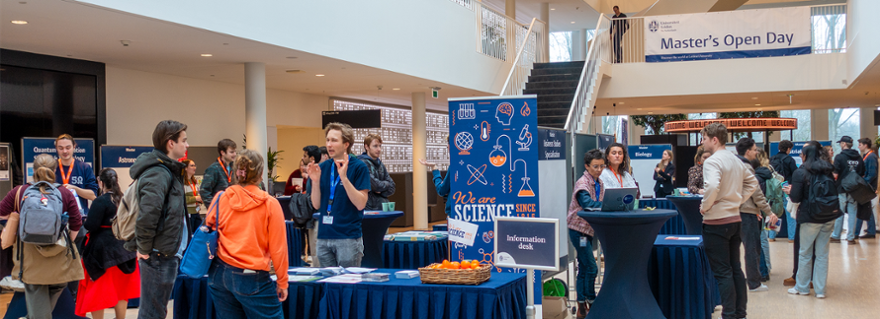
With lab tours, presentations and an information fair, Leiden University’s Master’s Open Day gave students a good impression of our master’s programmes and the career prospects that come with them.
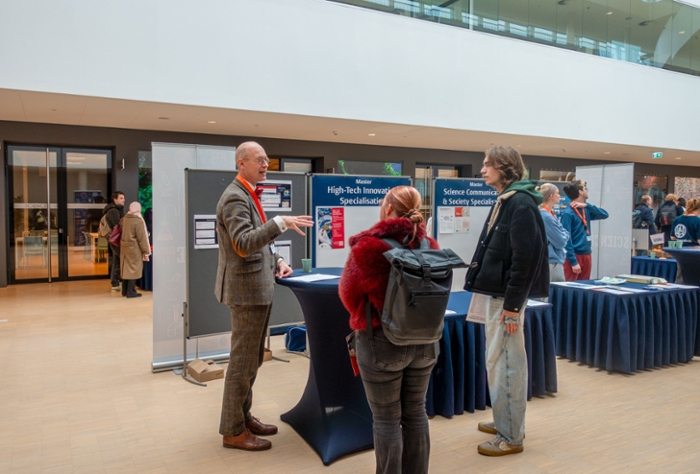
In the Gorlaeus building, the Faculty of Science stands are buzzing with activity. Curious students listen as Koenraad Schalm, programme director of the Master’s in Physics, explains the brand-new High-Tech Innovation Specialisation programme that starts on 1 September.
‘This master’s focuses on tackling questions within a business context. In academia, your work is driven by questions from physics or chemistry, but in industry, you want to build a machine, for example, and need physics or chemistry to make that possible. This specialisation lets you conduct scientific research with an industrial angle.’
The programme can be combined with a Master’s in Physics, Chemistry, Mathematics, Astronomy, or Computer Science. ‘Many of our students go on to careers in industry, and this master’s makes the transition more seamless,’ says Schalm.
Engineering and research
That combination is exactly what Physics and Astronomy student Yentl van der Tol is looking for. ‘I enjoy doing research, but I’m slightly more drawn to the industrial side.’ After completing an engineering minor in Delft, she realised that switching entirely to engineering would be ‘too much of a good thing’.
‘This master’s seems like the ideal blend of engineering and research elements. As for what job I’d like afterwards, that’s a difficult one. The dream job would be at ESA [European Space Agency], but more realistically, a job at a company with a space division. Space exploration is what interests me most, which is why I want to do this specialisation alongside the Master’s in Astronomy.’
Solar car
Further down the corridor, a packed classroom listens to a presentation on the Master’s in Quantum Information Science & Technology, a programme centred on researching, designing and building quantum information-processing systems. Pepijn Baggen and Mylene Butselaar, who are currently studying Data Science and Artificial Intelligence, leave the classroom together. For them, the open day is a chance to orient themselves.
‘It’s good to get a sense of what’s out there and what appeals to you and what doesn’t,’ says Baggen. ‘What’s interesting about this master’s is that it’s interdisciplinary and that you don’t necessarily need to follow the same path as your bachelor’s.’ Butselaar adds: ‘We both started with physics, so it’s nice to see that you can pick that up again.’
Their favourite part of the presentation was the solar team talking about their solar car. Each year, the team recruits new members to help build the next model, and that makes the master’s all the more attractive.
-
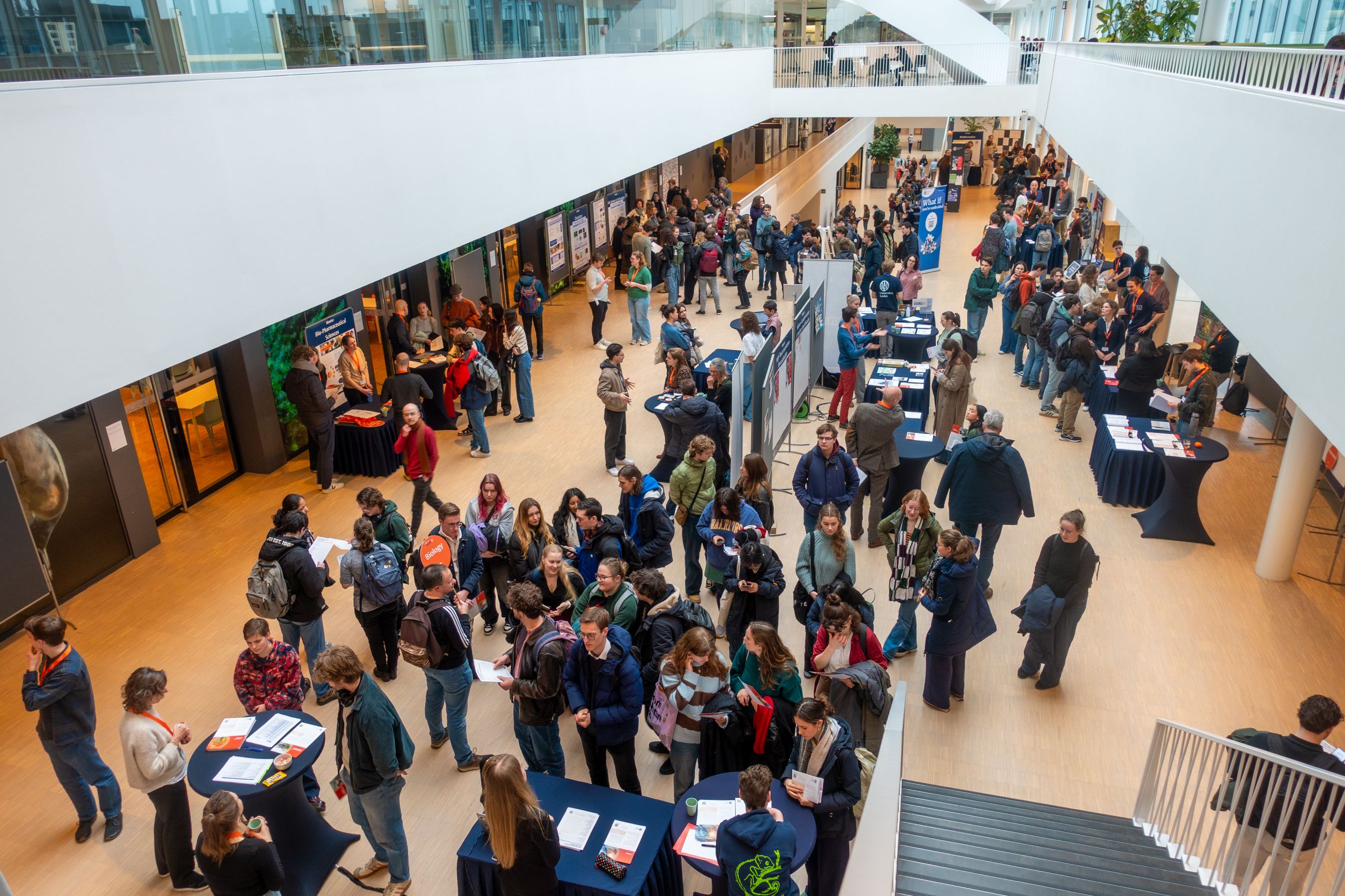
• In the hall of the Gorleaus building, stands offer information on the different master’s programmes. -
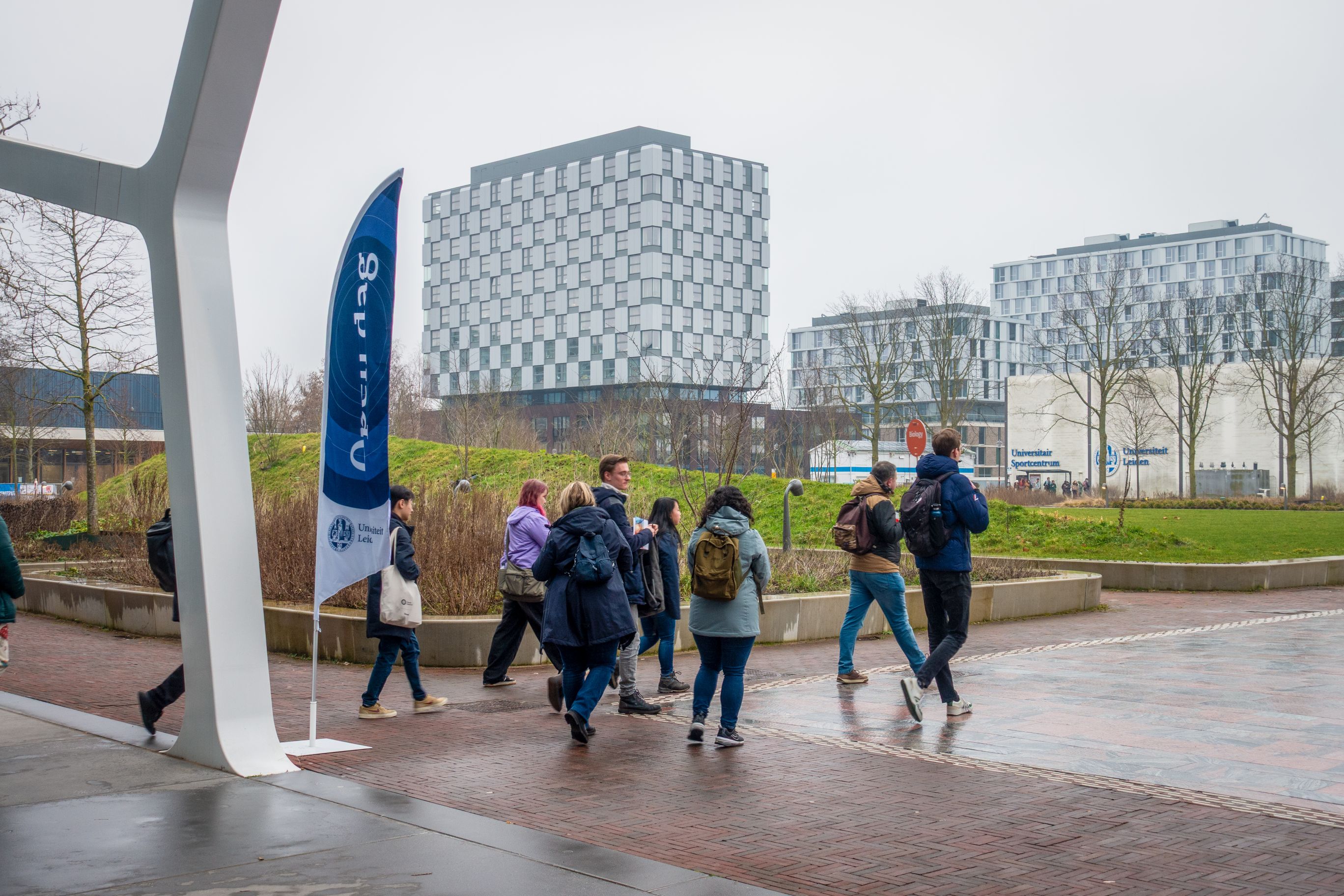
Students are given a tour of the labs.
Lab tours
It’s getting busier at the biology stand: the lab tour is about to start. Maaike Schriever, a Biomedical Laboratory Research student from Groningen, is joining the group. She’s not sure which master’s to choose. ‘There’s a minor in Groningen that I can take as a pre-master’s. I’m looking at master’s options across the Netherlands because that could influence which minor I choose.’
Beside her is Merit de Jong, who’s currently studying biology in Utrecht. ‘I find ecology really interesting, but don’t want to focus solely on research. I’d like to combine it with something else. That’s why I’m going to look at the Science Communication & Society specialisation.’ With that, the tour begins and the group heads outside towards the labs.