
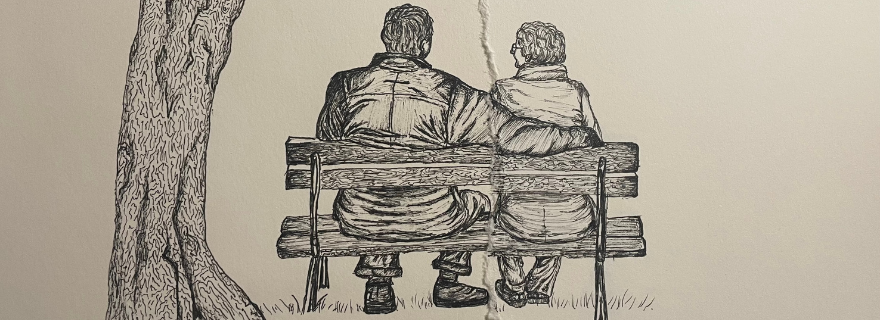
The scent of plums and paper swans: LUC students see how elderly people care for one another
What unfolded in shared kitchens, along narrow corridors and around Wednesday coffee tables became more than an assignment. It became a living exploration of what ageing means in practice.
Education at Leiden University College begins by stepping outside the classroom. In the Aging and Society course, students entered the senior housing complex Muidenstein in The Hague Southwest not as distant observers, but as listeners, neighbours and co-creators of knowledge.
Learning together, living together: research as encounter
The project was rooted in collaboration with Staedion Housing Corporation and the Thesis Hub The Hague Southwest. Together with resident volunteers, students were invited to ask a simple yet profound question. How do senior residents build social connections in and outside of the building? And what does this tell us about thriving in later life here, in this building, among these people.
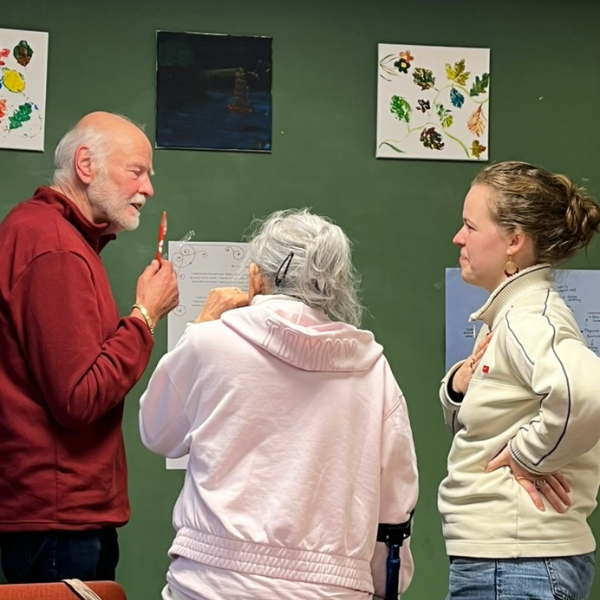
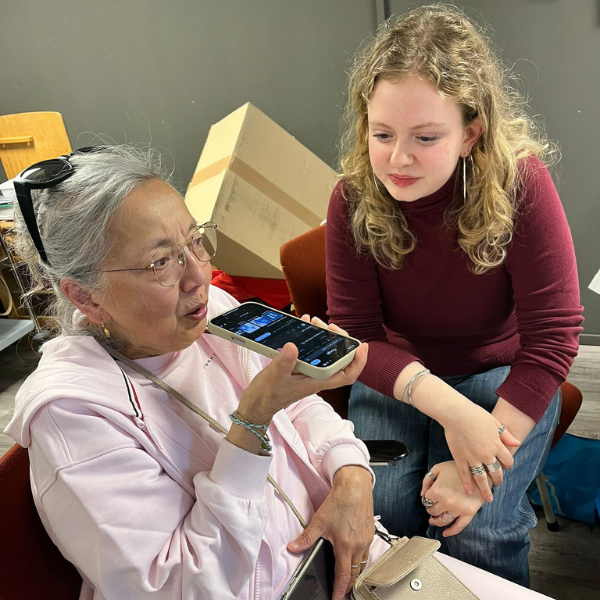
Societal engagement at LUC is not an abstract ambition. It is visible in autumn art workshops, in Christmas decorations hung together, and in conversations that stretch far beyond research protocols. Students did not only conduct interviews. They drank tea, folded origami cranes, decorated communal spaces and returned for feedback sessions where residents could respond to how their stories were represented. Knowledge moved in both directions.
Research led teaching in practice
The course drew on critical scholarship about ageing well, questioning dominant ideas of independence and productivity. Yet theory only came alive through encounter. Housing was examined not simply as infrastructure, but as social space. The communal room in Muidenstein, once lively with football matches and bingo, now hosts quieter coffee mornings. Its history of conflict, renewal and fragile revival revealed how Staedion’s liveability ambitions translate into everyday experience.
Through interviews, informal conversations and creative methods such as the three circle diagram, students mapped networks of care. They learned how independence can coexist with interdependence, and how dignity is sustained through small gestures. A neighbour who resets a clock after a power cut. A resident who leaves her door open so the smell of cabbage and plums drifts down the hall. Four windows that open at noon as a silent pact of mutual care.
Interdisciplinary perspectives on ageing
Ageing in Muidenstein cannot be reduced to one discipline. It is social policy and urban design. It is anthropology and public health. It is poetry, memory and architecture. Students combined qualitative research with storytelling, weaving sociological insight together with creative reflection. Poems questioned digital exclusion and generational inequality. Narratives traced how a candle, a fish tank or four hundred paper swans can hold together family, friendship and neighbourhood.
Connection and care in everyday spaces
In this way, the building itself became a text to be read. Behind its grey exterior lives a subtle infrastructure of attentiveness. Residents notice when someone does not appear at coffee morning. They cook soup for a sick friend. They accompany one another to the market. The corridors, at first glance dim and anonymous, are in fact pathways along which care circulates quietly.
Education at LUC aspires to cultivate exactly this kind of attentiveness. By engaging with The Hague, by grounding research in lived reality and by embracing interdisciplinary thinking, students discover that successful ageing is not merely about avoiding decline. It is about connection. And connection, as Muidenstein teaches us, is built one conversation, one open window, at a time.