
‘You can be excellent in your field, but that does not make you a good teacher’
Training students to become medical professionals is an important task of a university medical centre. But teaching does not always receive the space and recognition it deserves. This needs to change, says Professor Alexandra Langers. Medical education is a profession in its own right.
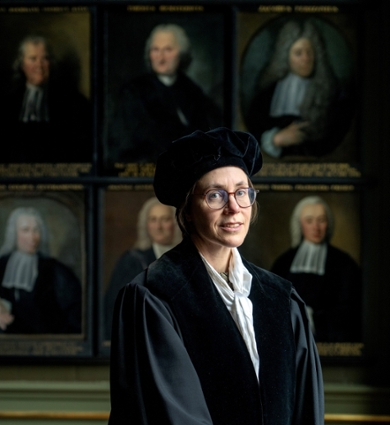
Alexandra Langers is Professor of Gastroenterology and Hepatology, with a focus on innovation and professionalisation in medical education. She is also Vice Dean of Education at the LUMC.
Your inaugural lecture is titled ‘Medical education: a profession in its own right’. Why is this?
‘At the LUMC, much of the teaching is given by specialists and can be in a medical or scientific field. You can be very strong in your field, but that does not make you a good teacher. It is something different to convey your knowledge clearly. That is what makes medical education a profession in its own right.’
You are a doctor and a researcher, and your chair focuses on education. Why do you want to dedicate yourself to this?
‘I really enjoy teaching. When I became a gastroenterologist, I was allowed to coordinate a teaching block quite early on. I could adapt it to the latest insights and to the interaction with students. I get a lot of energy from people who want to learn and make progress. If you invest in good supervision, it pays off straight away. That gives you immediate satisfaction.
‘At a certain point, I also started researching education. In medical research, you often want to understand disease mechanisms so you can develop or improve treatments. The same applies to education research. You do not innovate for the sake of innovation, but to introduce new teaching methods that work even better than the ones you used before. The good thing about education research is that it is close to the practice. You can keep adjusting the education based on what you find.
‘My enthusiasm for education also appears at the policy level. Besides my work as a doctor, I am Vice Dean of Education at the LUMC. In this role, I help shape the education strategy across the organisation. This includes all core tasks of a university medical centre, such as care, research and education. For me, this brings everything together.’
What research lines are you working on?
‘The Education Expertise Centre is the LUMC team that researches education. One research line focuses on technological tools, for example augmented reality. With special glasses, you see certain things in your surroundings that are not actually there, like with the Pokémon Go trend a few years ago. There are augmented reality apps that help students learn how to perform a physical examination of the lungs or an ultrasound of the heart. We are studying whether these apps can replace part of the regular teaching and is looks to be possible’
‘We also frequently use multiple-choice questions in medical education. Research shows that this is not the best way to test knowledge. Some students are very skilled at multiple-choice questions because they can tell the answer from how the question is phrased. But when you’re working, you don’t have multiple-choice questions. They must know why they make a certain decision. Short open questions are a better match for the medical practice. We are already working on this.
‘Our research also focuses on teacher professionalisation. There is the basic teaching qualification, but no real follow-up, when education keeps changing – the increased focus on diversity and inclusion, for example, or artificial intelligence. This requires continuous training. This is not easy at the LUMC because teaching is often only a small part of someone’s job. One thing I would like to move towards is core teachers. This is a specific group with a substantial teaching role that can receive proper training in this area. They have one foot in practice and one foot in teaching. This is especially important for skills training across programmes.’
What will society notice from your work as a professor?
‘We already see more attention for prevention and for careers outside the hospital in the medical curriculum. Until recently, the programme was very hospital driven. Teaching was also mostly provided by hospital specialists. This is now changing. We are training doctors who are firmly rooted in society.
‘We also focus on interprofessional learning and collaboration across disciplines. For example, we are researching with a PhD candidate how to train nursing and medical students together. We hope this will improve collaboration between nurses and doctors in the long term. Studies show that the quality of care improves when you train across disciplines.’
Where would you like the field to be in ten to fifteen years?
‘I hope that education in an academic hospital will be seen more as a main task. People do not always feel recognised for their achievements in education and do not always have enough time for it. Teachers also say that they would like more time and space to develop in teaching.
‘Part of the solution is more career opportunities in education. We are working on different career paths that make this possible. Another part is more recognition. Education is also a core task of an academic medical centre. Our professionals deserve this appreciation. We are working hard on this. I hope that education will eventually be valued as much as research.’
Alexandra Langers gave her inaugural lecture ‘Medisch onderwijs, een vak apart’ on 13 March. Read the lecture (in Dutch).