

Former Ministers: ‘It is like jumping aboard an extremely fast-moving train’
During an inspiring meeting at the Health Campus The Hague on 2 April, Jan Anthonie Bruijn and Jet Bussemaker reflected on their experiences in politics and looked ahead to the future of Dutch healthcare.
In an open conversation with Bruijn and Bussemaker, moderator Eduard Schmidt reflected on their time as government ministers. Together with the students, researchers, and healthcare and welfare professionals present they shared insights regarding the interplay between science, policy, and political reality. Both former politicians conclude: 'It’s as if you are jumping aboard an extremely fast-moving train. In a short space of time, you have to familiarise yourself with numerous policy dossiers, and you are sometimes confronted with the way your predecessor has left the ministry.’
At the same time, it is not possible to anticipate every eventuality. Bussemaker experienced this just two hours after her appointment, when civil servants took her aside during a welcome reception to inform her that the funds for personal budgets (PGBs) had been exhausted and that she would no longer be able to allocate any PGBs from the end of that week. She had to assure the Ministry of Finance that the shortfall would be offset by cuts elsewhere, and only then could the scheme continue temporarily. This set the parameters for her actions.

Politics as craftmanship
Bruijn and Bussemaker agreed that practising politics is a craft: something that is learned through experience or gradually developed over time. While substantive knowledge is certainly helpful, they emphasised that empathy for the issues at hand is particularly crucial. According to Bruijn, his background as a doctor was an advantage in his role as Minister of Health, Welfare and Sport. ‘During debates, I was able to draw on my experience by engaging with the matter in considerable depth, thereby steering the discussion in my favour.’ At the same time, they expressed strong appreciation for the high quality of the civil service. It may even be sufficiently robust that a ministry would continue to function even in the absence of a minister.
An important aspect of serving as a minister concerns how one’s message is received, with the media acting as both ally and adversary. Bruijn noted that making difficult decisions, such as excluding expensive medicines from the basic health insurance package, is comparable to delivering bad news in a doctor–patient consultation. ‘It is a hard message that people do not always want to hear and that can provoke anger in the recipient, and I quickly learned never to speak off the cuff or to express an opinion without due consideration.’
Lively discussion
Thanks to the active contribution of the audience, a lively and increasingly substantive discussion emerged between the former ministers. While the initial tone was light-hearted, with a playful call for more debate, the conversation gradually brought to the fore issues on which their political views genuinely diverged, such as raising the compulsory excess and the role of prevention in healthcare. Within this open and respectful exchange, there was space for both shared understanding and differences of perspective regarding the future of healthcare. Despite these political differences, their central message was the same: meaningful action is required to ensure the continued affordability and accessibility of healthcare in the future.
The shared message to participants was therefore clear: place yourself in the perspective of others, be willing to step outside your comfort zone, and reflect on your societal contribution. Those wishing to make their voices heard in politics were advised that this can be achieved through lobbying, or by becoming directly involved in shaping policy programmes within a political party at the local, regional, or national level.
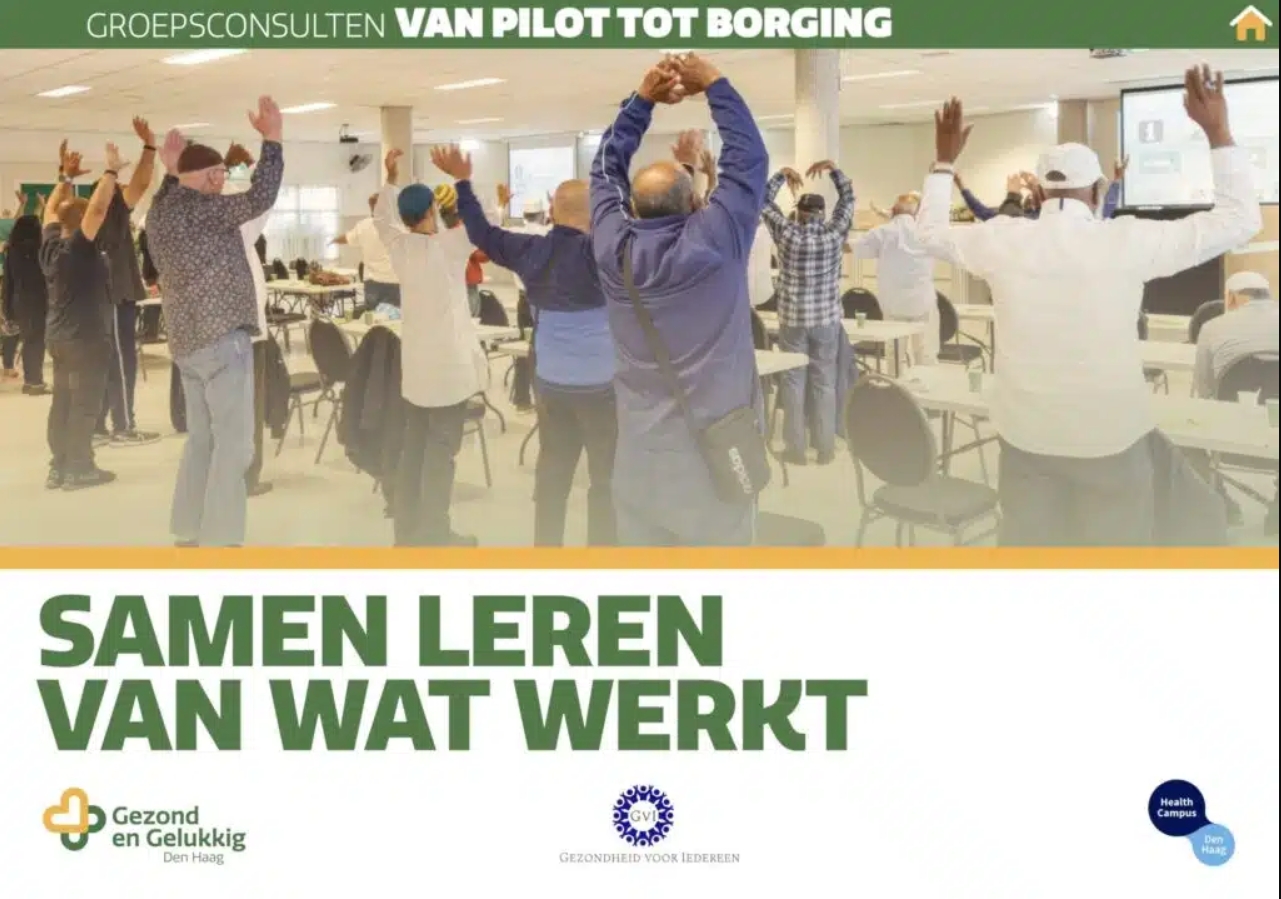
A notable moment was Bussemaker’s presentation to Bruijn of the document Learning Together from What Works on group consultations. It provided a concrete example of how reorganising care delivery can lead to both improved and more affordable healthcare. Interested? Read the report: Five Years of Group Consultations in The Hague: From Experiment to Established Practice – Healthy and Happy The Hague.