
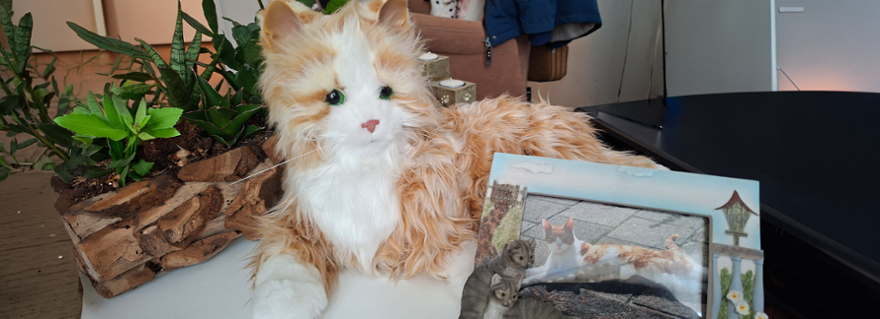
A cuddly toy with batteries: exploring the role of social robots in care for older people
From toy cats that purr to robot dogs that bark: what do such technologies mean for older people, healthcare providers and family members? A Dutch Research Council (NWO) Veni grant is enabling anthropologist Tanja Ahlin to investigate how animal-shaped robots can contribute to care for older people in the Netherlands.
In her Veni project, Paw Support: Animal-shaped social robots in elder care in the Netherlands, Tanja Ahlin is exploring the role of social robots in Dutch care for older people. Ageing populations are putting pressure on healthcare systems, while financial and human resources are becoming increasingly scarce.
The question is whether relatively simple technologies, such as plush robot cats and dogs, can make a meaningful contribution to sustainable long-term care. Social interaction is the main function of social robots, which some see as robots, whereas others see them as cuddly toys with batteries.
‘I’m an anthropologist, so humans are central for me’, says Ahlin. ‘Technology has become so intertwined with our lives that it is impossible not to study it. I’m mainly curious about new technologies and how they influence our relationships with one another. And how we care for each other, and who we become through these relationships.’
According to Ahlin, attention often focuses on major technological developments such as AI, when the everyday, seemingly simple technologies can have subtle but important effects.
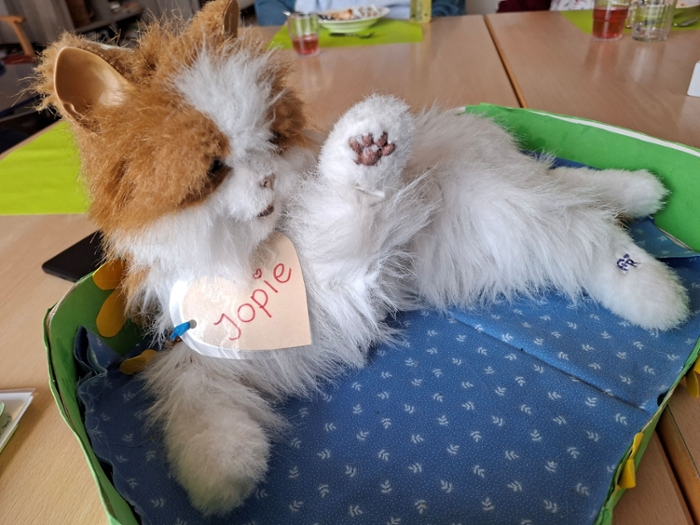
Where do these ‘stray cats’ come from?
For her research, Ahlin is visiting different care homes across the Netherlands. She observes how residents, healthcare providers and family members deal with social robots. She also wants to know where these cuddly robots come from. ‘Sometimes it seems as though they appear out of nowhere’, she laughs. ‘A bit like stray cats. One resident said to me: “The cat was suddenly there and she looked so lonely I took her with me. Now she’s no longer alone.”’
She’s fascinated by the informal way social robots end up in Dutch care facilities. In countries such as Denmark, this technology is actively promoted or introduced through government policy. Its spread across the Netherlands often appears to start at the grassroots level: through staff, family members or residents themselves.
Alongside her fieldwork at care facilities, Ahlin wants to talk to developers and robot implementation consultants, retailers who sell the robots and policymakers who are considering the future of care for older people. She is also studying online discussions about social robots.
‘Family members want to talk about what these robots can mean for their loved ones.’
Struck by people’s openness
Although the research has only just begun, the first days of her fieldwork have already made an impression. ‘I’m surprised by how open everyone is and how curious people are’, says Ahlin. ‘Family members want to talk about what these robots can mean for their loved ones.’
But it’s not just the families who want to talk about what these robots can mean. She met one woman who had four robot cats in her room. One was her own, one belonged to the facility and no one knew where the other two came from. At first, the woman treated her robot cat as if it were a real animal. ‘Then a bit later she turned the toy over, pulled aside the fur and pointed to the batteries. “You do know it’s not real, don’t you”, she said.’
According to Ahlin, this shows how complex the relationship between a human and a robot can be. People often know full well that these aren’t real animals, but that doesn’t mean that they can’t form an attachment to them.
Who benefits from social robots?
One key question of Paw Support is who actually benefits from this technology. The animals often remind people of pets they had in the past and offer company, calm and safety. ‘This can help improve older people’s enjoyment of life. It’s definitely not a sign of loneliness, nor is it sad.’
Ahlin also wants to understand why some people or institutions are reluctant. ‘I’m also visiting care homes that don’t use social robots too. I want to know why not.’
Could social robots help people feel calmer or less lonely and even lead to a reduction in the use of medication?
Practical guidelines for care providers
The aim of the project is not only to understand what social robots are and how they work within care for older people, but also to develop practical guidance. ‘A care provider told me they wished there was a handbook on how to use social robots in healthcare. But there isn’t one.’
Ahlin therefore wants to develop guidelines based on her findings for care homes, care providers, family members and policymakers. These should help them decide when social robots are worthwhile, who they are suitable for and when other forms of support would be better.
She is also exploring other possible effects. For example, could social robots help people feel calmer, reduce loneliness or even lead to a reduction in medication use? ‘These are questions I want to find answers to in the next few years.