
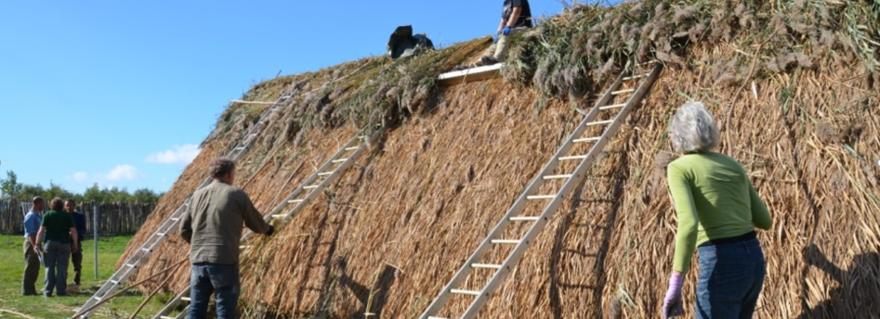
Throwback to the Living in a wetland landscape symposium
Reaching the end of the academic year, we look back fondly on the symposia, conferences and events that our faculty hosted in the previous months. One such symposium marked the end of the 5-year long research project ‘Putting life into Late Neolithic houses: investigating domestic craft and subsistence activities through experiments and material analysis’. Friday March 13th a group of about 200 people gathered in the Reuvenshal and online to celebrate the end of this research project led by Annelou van Gijn.
The end of an era
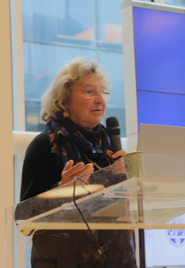
To celebrate the end of the project the team organised a symposium. With a packed programme the symposium kicked off. All the research and results of the last 5 years were presented in 30-minute presentations and the day was concluded with a discussion.
Together the researchers painted a picture of the landscape, dietary habits, tools and crafts, vegetation and housing of the people of the Late Neolithic Vlaardingen culture. It started with an introduction of the project by Annelou van Gijn and Jeroen ter Brugge, chair of Masamuda in Vlaardingen. This is the archaeological educational centre where the Late Neolithic house reconstruction is situated which formed the focus of the project.
Fish scales and milk
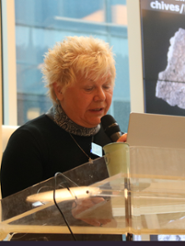
Lucy Kubiak-Martens presented her and her colleagues work on culinary practices of the western Netherlands during the Neolithic. She explained how the presence of for example fish scales and ruminant lipids in cooking pots showed different cooking recipes: on the levees they prepared fish with leeks, on the coastal dunes, cereals with milk.
A hide working industry?
The study of the microscopic wear traces on tools made of flint, ground stone, bone and antler tools by Annelou van Gijn and her colleagues and students showed what kind of craft activities people carried out in the past. On the river levees people made bone tools, split plants to make fish traps and used bone awls to make coiled baskets. In the area of the coastal dunes a large amount of hides were cleaned and prepared, in fact probably much more than the locals would need.
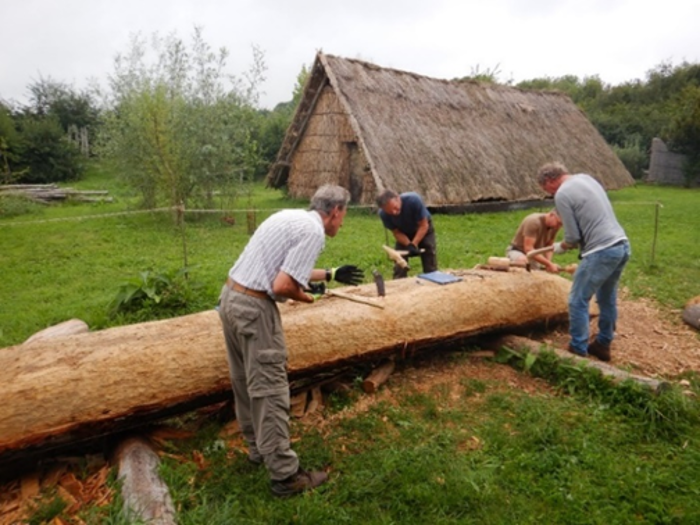
Lasse van den Dikkenberg was a PhD researcher at the project and recently defended his thesis on object biographies of the flint finds of the Vlaardingen culture. His research showed that the flint used in these coastal settlements was not local but transported there from the south. Combining these findings with the use wear indicating large scale hide production led him to hypothesize that this excess of hide products may have been exchanged for flint from the south. People therefore must have been very mobile. Equipped with this information the volunteers of the Masamuda centre built a dug-out canoe, using only Stone Age tools.
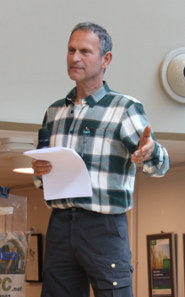
(Pre)historical competence and modern incompetence
The discussion at the end of the day also attracted an enthusiastic audience. Moderated by Luc Amkreutz, the audience could now discuss their thoughts and theories and build off of each other.
A question came from the audience directed at Leo Wolterbeek: ‘as the master builder in a lot of these projects, does everybody need to have a level of knowledge and skill or is one more experienced master sufficient?’
Leo answered that he expects everyone at the time to have learned these skills through play at a very young age and that, by adulthood, these skills would be completely mastered. He and the student that asked the question, agree that something like building a house is not as specialised as, for example, flint knapping.
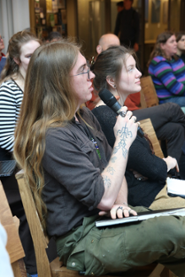
Diederik Pomstra, who is also in the audience, piped up saying that he ‘of course likes to hear people say that they think flint knapping is such a specialised skill.’ However, according to him, ‘finds from Vlaardingen are really not that special, everyone could make those tools. We should not underestimate how incompetent we are.’ This statement is met with laughter and agreement from the audience.
The discussion then continued on how much material is actually needed to learn how to knap flint, how important a good teacher is and how long it would take to achieve different milestones.
Final words
Annelou ended the day with words of thanks to people who worked on the project, those who helped organize the symposium, and everyone who attended. Her words were met with approving whistles and applause.