
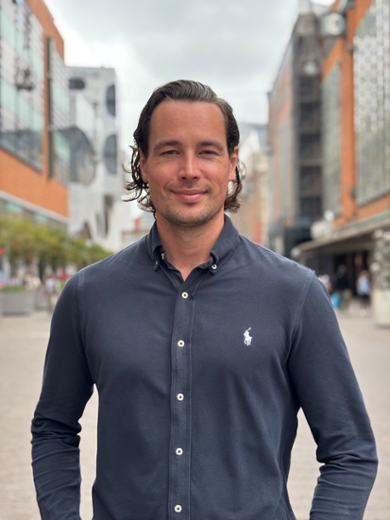
Alumnus Bas Jorissen: ‘I want to work with clients we’re proud to represent’
While many tax law graduates opt for an established firm, Bas Jorissen chose a different path. He set up his own tax consultancy firm, specialising in start-ups and scale-ups. Read about his student days, career, and future plans.
Why did you decide to study tax law?
‘I always felt I had a natural instinct for both economics and language, so in hindsight tax law was a logical choice. But when I was exploring my study options, becoming a tax lawyer was actually the last thing on my mind! It’s my father’s profession, and I thought it would look like my career had been planned from the start.
What appealed to me in Leiden was the combination of law, debate, and the role of economics and politics. So, I first started Law and Business Studies. I found courses like Roman law hard going, but everything suddenly clicked into place when I took the course Introduction to Tax Law. As you don’t have much prior knowledge, you largely rely on instinct and logic for that course, and I felt that it was right down my street. Once that happens, studying becomes a lot more enjoyable.’
What kind of student were you?
‘I first still had a bit of a secondary school mentality: your grades helped you get into university, but after that they didn’t matter so much. My priorities were the Minerva student association, working in a pub, and making friends. Looking back, I'm glad because it helped me develop my soft skills – something that still helps me every single day.
As I progressed further into my studies and the subject matter, and became more aware of the social and political context of tax law, my interest was really sparked. I enjoyed my studies, got more confident about what I was good at, and my grades went up.'
Why did you decide to start your own firm so early in your career?
‘I didn't get much satisfaction from routine work, and certainly not from doing things simply because they were expected of me. Looking back, I think that's because I was a went to a Montessori school. I need the freedom to come up with my own ideas and that wasn’t a good match with being a junior employee at a large firm. Understandably so, by the way, but it wasn’t for me. More importantly, I saw an opportunity. I have tremendous respect for people who try to create something new, and usually something that really makes a difference. My interest in start-ups and scale-ups coincided with a renewed focus in the Netherlands on venture building and entrepreneurial culture.
About ten years ago, awareness grew of how important start-ups and scale-ups are to the dynamics and earning capacity of our economy. At the time, relatively few tax advisers seemed to be focused on that area so it was clearly a gap in the market, and I thought: that's what I want to do.’
How do you envisage the future of your company?
‘I want us to work with clients we're proud to represent, not clients you'd rather avoid mentioning but who happen to pay well. It's also important to me that our employees retain their independence, without being micromanaged. I’d like everyone to stay in touch with their inner Montessori child as it were. So, I'm trying to create the kind of workplace I would have wanted for myself.
My goal is to develop from this basis to become a major player in the Dutch market, maintaining the focus on start-ups as an early indicator for the development of our broader services. I'd like to become a robust, specialised firm with around 50 to 60 employees, satisfied clients, and motivated colleagues. If we can support that with a strong platform where technology plays an important role, if everyone genuinely enjoys being part of it, and if we can contribute – even from the sidelines – to the Dutch innovation ecosystem, then I'll be very happy.’
You’re also a guest lecturer at the university. What do you like about teaching?
‘I've experienced firsthand the effect an inspiring teacher can have. I hope to be that person for someone else. In my classes, I try to tell a story that's a bit unpredictable and humorous, but coherent in the end, to spark students' interest in the subject. I'd love it if someone decided to enter this field because of one of my “entertaining” lectures.’
Finally: what advice do you have for our students?
‘Enjoy every aspect of student life in Leiden. There's an unwritten understanding here: study hard, and you'll get a good job. But I think that leaves a lot of creativity untapped. We don’t all go to university with the goal of landing a good job; you can also start your own company, for example. Your student years are the time to explore what you want and what you're good at, even if that’s outside the traditional path. And if your talents happen to flourish on that particular path, that's fine too. But seek out the more unconventional people around you who inspire others. Those special friendships are a blessing that stays with you long after your student days in Leiden are over.’