
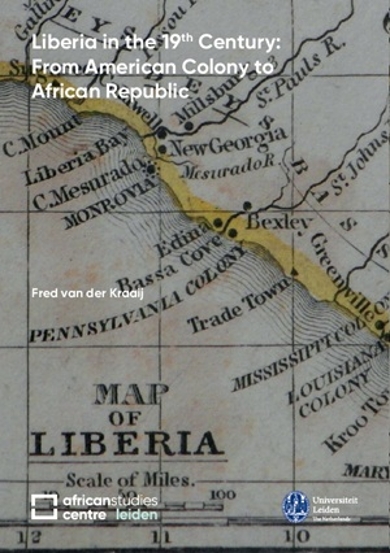
Just out: Liberia in the 19th Century: From American Colony to African Republic
The book ‘Liberia in the 19th Century: From American Colony to African Republic’ tells the little-known history of the origins of the West African country of Liberia. The country would not have existed without the inhumane transatlantic slave trade.
Between the 16th and 19th centuries, millions of Africans were forcibly shipped to North and South America to work on plantations there. Towards the end of the 18th century, an anti-slavery movement emerged in Europe, which gained increasing support in the early 19th century, also in the United States of America. Here, in 1816, white Americans created the ‘American Colonization Society’ (ACS).
The first independent African republic
Between 1822 and 1847, some 4,500 American ex-slaves and free-born Blacks, unwanted and ill-treated in the country of their birth, sailed to West Africa to settle in an unknown territory with an unhealthy, harsh tropical climate. Their uncertain colonisation venture was organised and funded by private white American organisations, with significant military, financial, and political support from the US government. In 1847, Black American settlers proclaimed the first independent African republic.
No empty land
But the settlers were not settling in an empty land. This led to many conflicts with the indigenous population, who were excluded from the new republic. There were also many conflicts with slave traders - who were still active in the area - sometimes in collaboration with local population groups. The Scramble for Africa also brought numerous conflicts with hungry European colonial powers. This situation was further exacerbated by internal divisions within the settler group. The financial and economic costs of these conflicts and threats were high. By the turn of the century, Liberia was war-weary and nearly bankrupt. The country had not yet begun to develop. On the threshold of the 20th century, the survival of Liberia’s political independence seemed uncertain.
Discovery
While researching the history of Liberia’s origins, the colonial period (1822–1847), and the republican period (1847–1900), author Fred van der Kraaij made a remarkable discovery. In this book, published by the African Studies Centre Leiden, Van der Kraaij reveals that the name Liberia already existed in 1822, and does not date from 1824, as is the official version.
About the author
Fred van der Kraaij is a Dutch researcher and author with professional experience in Sub-Saharan Africa since 1972. He holds a PhD in Economics from Tilburg University. His dissertation on Liberia’s ‘Open Door Policy’ was published by the Übersee Museum Bremen, Germany, as An Economic History of Modern Liberia. He lived and worked in West Africa for sixteen years, including five years in Liberia, where he taught economics at the University of Liberia. Subsequently, he worked in various positions in fifteen other African countries.
The book has been published open access and is for sale. Read or buy it on the ASCL website.