
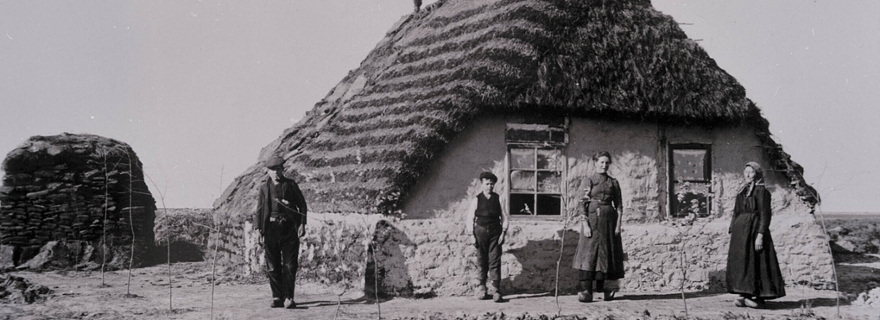
‘The countryside is more than just farmers and tractors’: Judith Pollmann to use Spinoza Prize to promote rural history
Professor Judith Pollmann is using her Spinoza Prize to set up a research group aimed at better documenting the history of the Dutch countryside. Together with historian Arjan Nobel, she talks about their plans.
Rural history has long been a neglected area in Dutch political historiography. In a region that was already characterised by significant urbanisation as early as the sixteenth century, the city almost automatically took centre stage in historical narratives, partly because ‘the countryside’ was, in practice, a patchwork of vastly different political institutions.
‘The rules in one village could be completely different from those in another just a few kilometres away,’ explains Pollmann. ‘Institutions, too, could vary greatly from place to place. To make sense of it all, you need to know quite a lot, especially as sources are often not neatly organised together in a single archive.’
What’s more, Pollmann’s team is interested in the history of the countryside as a whole, not just that of agriculture. ‘The countryside wasn’t just made up of farmers and farmhands,’ she explains. ‘It was also home to whalers, weavers, maidservants, traders… Rural dwellers were also affected by political decisions and shifts in power, but that does not automatically make them passive victims. On the contrary, they themselves helped shape their lives and their region. Land consolidation, mechanisation and new technology have brought about the greatest transformation of the landscape in history, resulting in enormous social changes and even migration. Yet there is no section on this in the history canon.’
Guide
Historian Arjan Nobel is one of the newly recruited members of the research group. He will be working on a ‘guide’ for historical rural research. ‘Until now, no attempt has ever been made to explain in an accessible way how, for example, you conduct research into the eighteenth century in Drenthe,’ says Nobel. ‘Which institutions do you have to deal with, and how did the connections work? Anne Petterson and I want to provide more insight into this. She’ll be covering the nineteenth and twentieth centuries, whilst I’ll be looking at the sixteenth and seventeenth.’
This guide is intended to help researchers get started, but also to provide guidance to people conducting local historical research. Nobel: ‘There is an enormous amount of knowledge at the local level. Many historical societies have real experts, but they are often very focused on their own village or region. We want to help them identify how their local story fits into a wider context. Particularly with all the talk these days about the countryside, I often find myself thinking: a little more knowledge wouldn’t go amiss.’
‘That comparison also highlights the added value we can offer as academics,’ adds Pollmann. ‘If you compare a number of these local histories side by side, you see broader themes that raise questions. For example, a number of colleagues in Leiden have specific questions about rural rebellion, the role played by landowners, literacy, or the relationship with colonial practices. It is no coincidence that the person who devised the ‘colonies for paupers’ in Drenthe also devised the cultural system in Java. We want to gain a better understanding of how such processes of power and influence operated. For example, did the driving forces behind change live in the countryside themselves? Or did they come from outside?
Experienced group
The Spinoza Prize enables Pollmann to address such questions with a group in which most members are already working as university lecturers or associate professors. ‘Don’t get me wrong, supervising PhD students is also fantastic, but at a time when our research time is under pressure, it’s important to be able to offer people this opportunity. It’s really rewarding to see how quickly the discussions and research progress when everyone has experience.’