Better understanding cancer drugs – Leiden spin-off Omivera receives seed investment
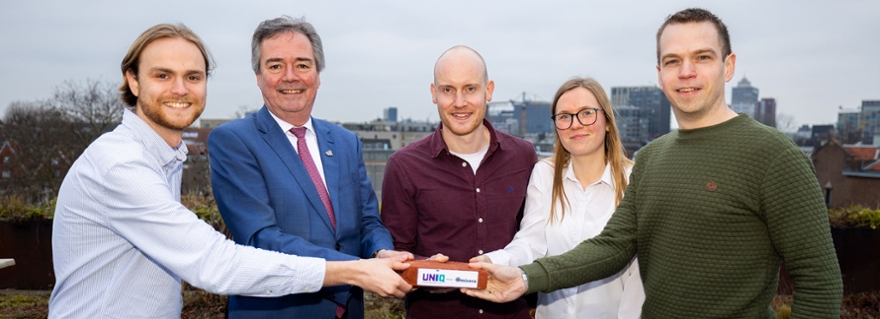
How do you know if a drug will actually work? The Leiden-based spin-off Omivera is developing a new technology that could provide clearer answers. The young company received a seed investment from the investment fund UNIIQ to support its development.
Omivera is creating a new technology for drug research called CellEKT. Using a method known as ‘kinome profiling’, researchers can get a functional overview of what is happening inside a living cell.
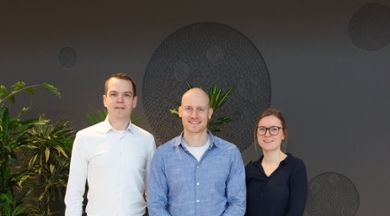
The technology was developed by Leiden researcher Joel Rüegger and his colleagues in the laboratory of Mario van der Stelt, in collaboration with pharmaceutical company Roche. The work was supported by the Oncode Institute and Oncode Accelerator. LURIS, the Knowledge Exchange Office of Leiden University, guided the process and created the conditions under which a long-term collaboration with Roche was established.
UNIIQ, Oncode Accelerator & Oncode Institute
UNIIQ is an investment fund that helps young companies further develop their technologies and bring them to market.
Oncode Accelerator is a public-private partnership that is partially funded by the Dutch National Growth Fund (NGF), aiming to innovate and accelerate the development of new cancer therapies by placing cancer patients at the core of preclinical therapy development.
Oncode Institute is a Dutch cancer research and innovation organisation dedicated to accelerating breakthroughs in cancer research and translating them into impactful diagnostics and treatments.
The new platform helps researchers understand how medicines act in living cells. It bridges the gap between traditional laboratory tests and what actually happens in patients, making it possible to identify earlier in the research process which drug candidates are promising and which are not.
Proteins play a key role
The technology focuses on proteins called kinases. These proteins play an important role in processes such as cell growth and metabolism and have long been key targets for drug development. However, they are difficult to study using conventional methods.
In joint studies with Roche, the Leiden researchers found that results from traditional lab tests do not always reflect what happens inside living cells. ‘Measurements in cells using our new CellEKT technology give a more reliable picture of what we later see in patients,’ says researcher Joel Rüegger. ‘This helps scientists make better decisions during drug development.’
From fundamental research to real world impact
Omnivera is now active as a Contract Research Organization (CRO). 'Oncode Institute played an important role in shaping CellEKT from academic research into a translational technology,' says Rüegger. 'And the UNIIQ investment now allows us to take the next meaningful step toward real-world impact.' With the investment, the company can continue to build its platform and expand its commercial activities.
Omivera is based at Leiden Bio Science Park and is a spin‑off of Leiden University. The company exemplifies how fundamental academic research can grow into applications with real societal and medical impact. ‘Bringing scientific discovery to the market means turning deep academic insights into technologies that accelerate real drug discovery,’ says Sara Cigna of LURIS, the Knowledge Exchange Office of Leiden University. ‘It strengthens Dutch innovation in life sciences and ensures that publicly funded research delivers tangible societal and economic impact.’