
Quantum research in two ways: from proving someone's location to simulating financial markets
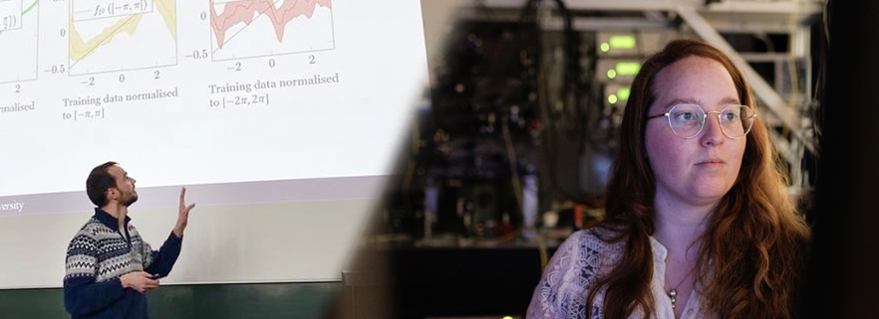
Quantum physics may sound abstract, but PhD candidates Kirsten Kanneworff and David Dechant show that quantum research can also be very concrete. Together, they are investigating how quantum technology can change the world.
While Kanneworff worked in the lab to study how quantum optics can be used to prove someone's location, Dechant focused on quantum computing for dynamic systems, such as the financial world. The two researchers are defending their doctoral research this week.
How do you prove that someone really is where they say they are?
Imagine: you receive an email from someone posing as your bank, asking you to enter your personal details on a website. How can you verify the sender's identity?
Kanneworff investigated a smart way to check whether someone is really in a certain place: quantum position verification. ‘The idea for this project came about during my master's degree,’ she says. ‘I found it an interesting subject. The combination of optics and quantum communication really appealed to me, especially since it has a clear application.’
Quantum information cannot be tampered with
In quantum position verification, multiple controllers simultaneously send signals to the person who wants to prove their location. By measuring very precisely how long those signals take, they can verify if it matches the location provided by the person. ‘The process is made much more secure thanks to quantum physics,’ explains Kanneworff. ‘That's because information in quantum states cannot be copied.’ Although quantum position verification can still be broken in some cases, overall that makes it much harder to temper with.
In the optical lab, Kanneworff studied single light particles (photons) emitted by a quantum dot. She investigated how these photons can travel through long glass fibres and optical devices without losing their properties. ‘Ultimately, this resulted in significant advancement towards an experimental demonstration of quantum position verification,’ she says.
-
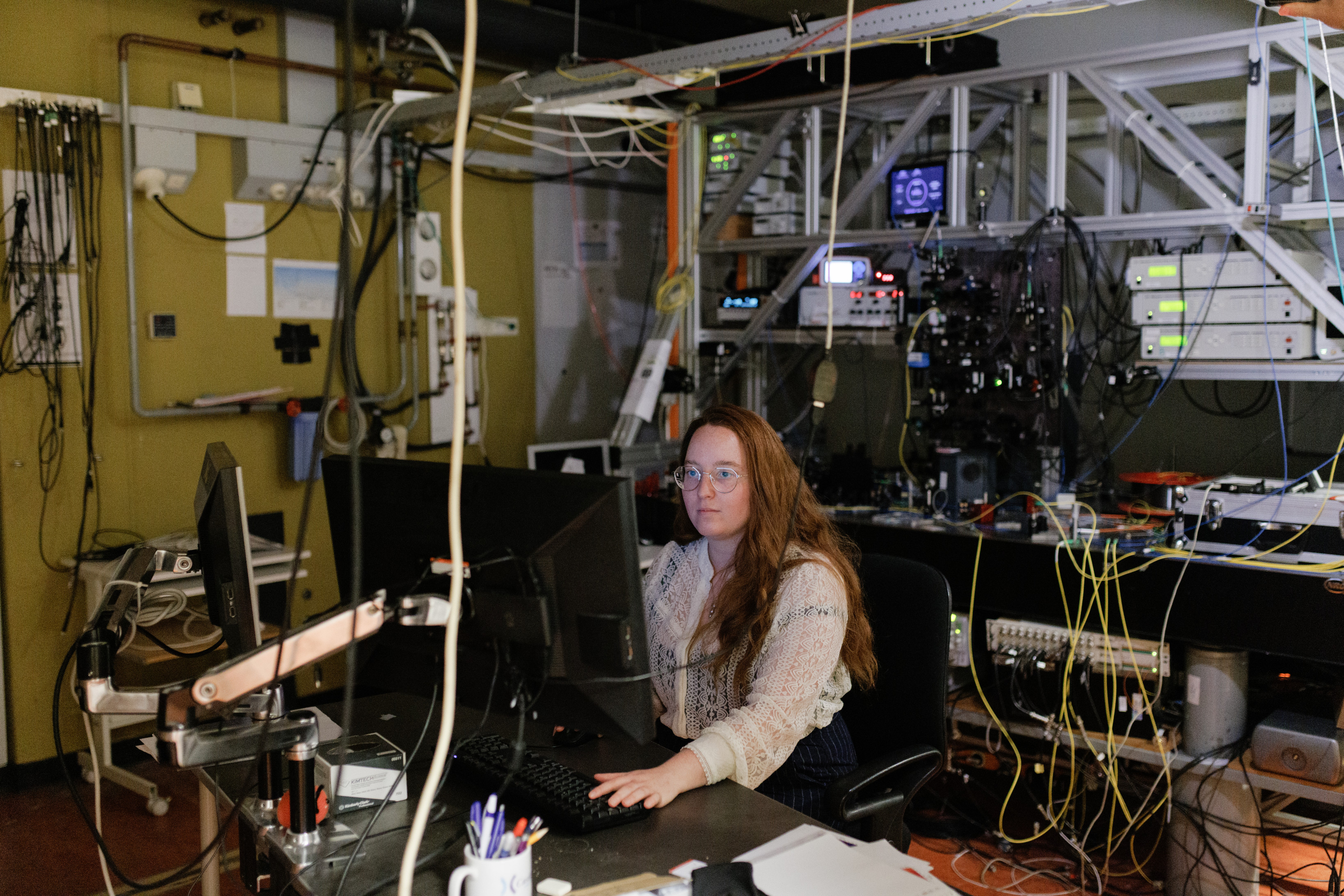
Kirsten Kanneworff in the quantum optics lab (photo credit: Jordi Huisman) -
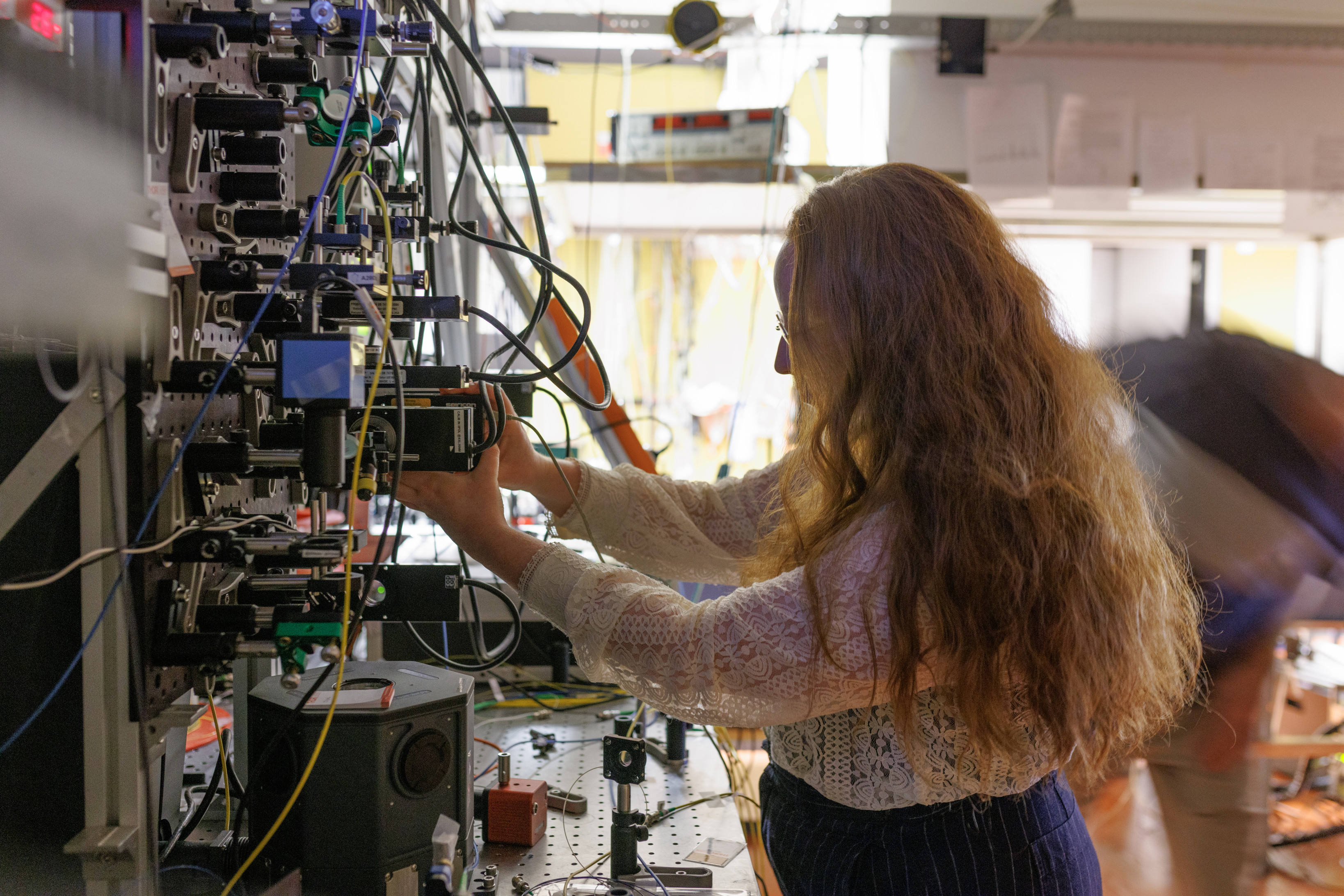
Kirsten Kanneworff in the quantum optics lab (photo credit: Jordi Huisman) -
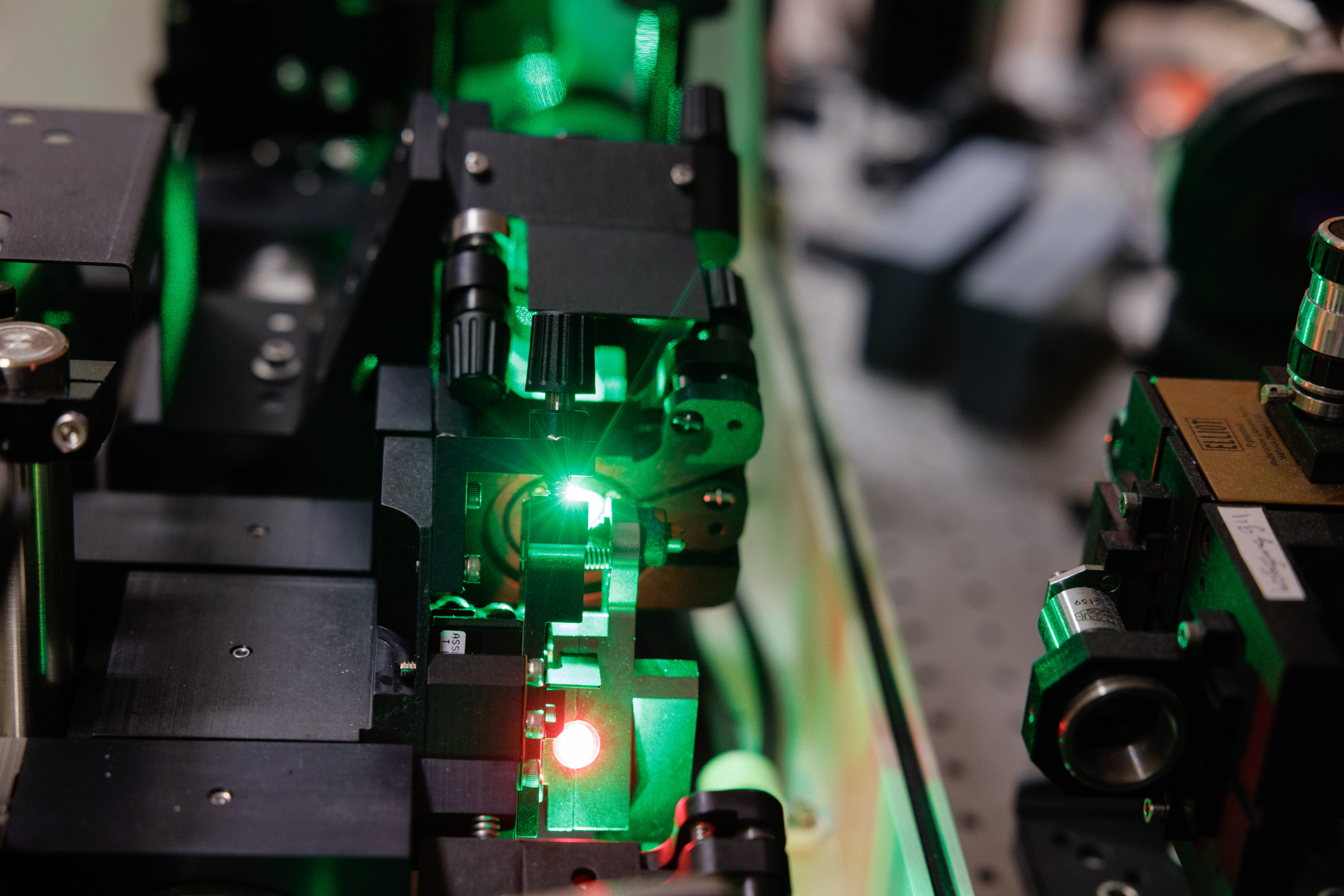
One of the setups in the Wolfgang Löffler quantum optics lab (photo credit: Jordi Huisman)
Quantum calculations for dynamics and financial models
Dechant's interest in quantum was sparked during an exchange semester at the National University of Singapore during his bachelor's. ‘I found it immediately very interesting due to the combination of physics, math and computer science, and because of the possibility of applying this research as a technology one day.’
Now his research revolves around quantum computing, a new way of computing that classical computers cannot keep up with. ‘Impressive progress has been made with quantum computers in recent years, but they are still too limited and too expensive,’ he explains. ‘To investigate how these machines might work in practice, we therefore use mathematical tools or simulate quantum calculations on classical computers.
In his research, he looks at dynamic systems — in other words, how a system changes over time. Examples include mathematical models such as differential equations or time series. These can be used, for example, to identify patterns in financial markets, that can subsequently be used to make predictions about future price movements.’
A quantum future in the making
Although both projects have different applications, they demonstrate how quantum technology offers fundamentally new ways of processing information, solving problems and improving security. These PhD theses show that the quantum world is no longer just theory but is increasingly having a practical impact.
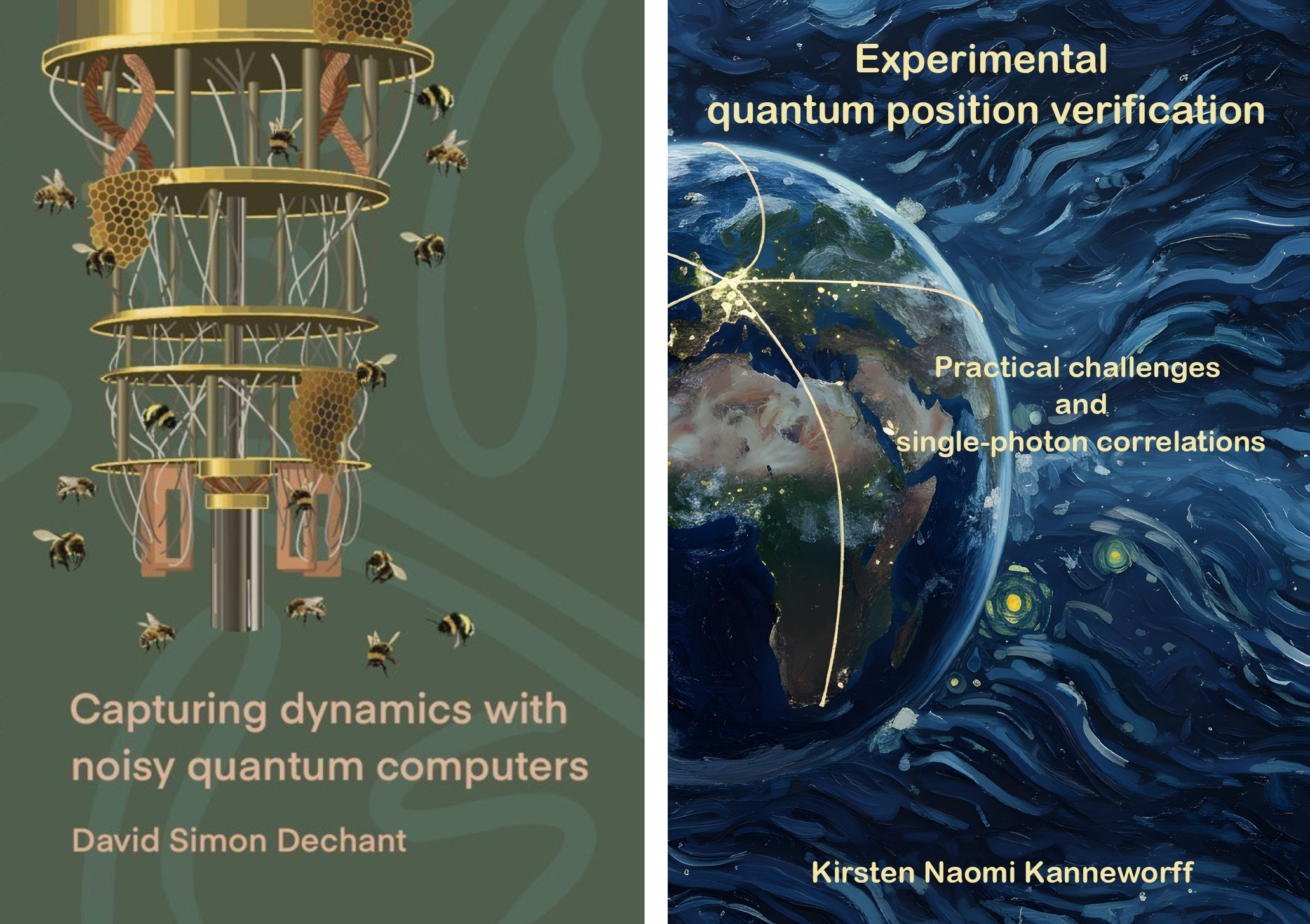
David Dechant will defend his thesis ‘Capturing dynamics with noisy quantum computers’ on 17 February. His supervisors are Vedran Dunjko and Jordi Tura. The cover of his thesis was designed by Zhenya Cheipesh.
Kirsten Kanneworff will defend her thesis ‘Experimental quantum position verification: practical challenges and single-photon correlations’ on 18 February. Her supervisors are Wolffgang Löffler and Dirk Bouwmeester. She designed the cover of her thesis herself.