
New simulations reveal the cold, dusty reality of galaxy formation
Leiden scientists lead COLIBRE, a groundbreaking set of cosmological simulations. By including key missing physics, cold gas and cosmic dust, they offer the most realistic picture yet of how galaxies formed and evolved since the dawn of time.
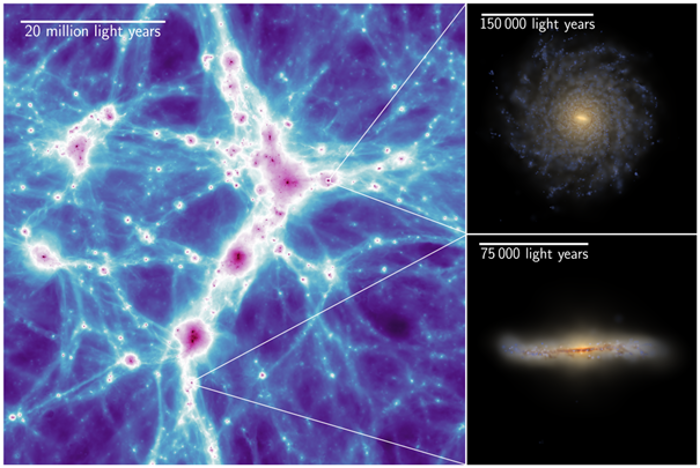
Unlike earlier simulations, COLIBRE models cold gas and cosmic dust inside galaxies. By including these ‘raw materials’ and using far more computing power, it successfully reproduces galaxies observed today and in the early universe by the James Webb Space Telescope (JWST). The results, published in Monthly Notices of the Royal Astronomical Society, show that the standard cosmological model can explain galaxy formation and growth more accurately than previously thought. Only a few crucial pieces of physics were still missing.
Digital cold gas and dust grains
Earlier simulations couldn’t let gas inside galaxies cool below about 10,000 degrees Kelvin, hotter than the Sun’s surface, because colder gas was too complex to model. Yet, observations show that stars form in much colder gas. COLIBRE includes the physical and chemical processes needed to model this cold interstellar gas directly.
COLIBRE also simulates small dust grains, which strongly influence galactic gas. Dusts helps form hydrogen molecules, which dominate the cold gas content of galaxies. It also shields gas from harsh ultraviolet radiation and strongly affects how galaxies appear in telescopes.
How does radiation affect our observations of galaxies?
Dust namely absorbs ultraviolet and optical light from stars and re-emits it in the infrared, shaping many astronomical observations. By modelling dust directly, COLIBRE opens new ways to compare simulations with real data. Dust namely absorbs ultraviolet and optical light from stars and re-emits it in the infrared, shaping many astronomical observations. By modelling dust directly, COLIBRE opens new ways to compare simulations with real data.
Thanks to advances in algorithms and supercomputing, COLIBRE uses up to 20 times more resolution elements than earlier simulations. This lets scientist simulate larger volumes with greater detail and better statistics.
Exploring galaxies in a virtual laboratory
COLIBRE shows that realistically modelling cold gas, dust, and outflows form stars and black holes are crucial for understanding galaxy evolution. It provides a powerful new ‘laboratory’ for testing theories, interpreting observations, and creating virtual observations to check how astronomers analyse real data.
‘With COLIBRE, we finally bring these essential components into the picture.’
‘Much of the gas inside real galaxies is cold and dusty, but most previous large simulations had to ignore this,’ says project leader Joop Schaye, from the Leiden Observatory. ‘With COLIBRE, we finally bring these essential components into the picture.’
The simulations confirm that the standard cosmological model remains consistent with observations of galaxy evolution, including some previously thought to be challenging, such as the masses of early galaxies. ‘But COLIBRE shows that, once key physical processes are represented more realistically, the model matches what we see,’ says Evgenii Chaikin of the Leiden Observatory, lead author of several accompanying COLIBRE papers.
Leiden physicist Matthieu Schaller focused on simulation software and running large-scale simulations. ‘For me, these results are remarkable, as they represent the most realistic simulations of the universe ever made’, he says. ‘They will teach us more about the link between astrophysical observations and cosmology and the fundamental building blocks of our universe. They provide a crucial tool for interpreting modern survey data.’
Pushing the limits of cosmic simulations
Some mysteries remain. The enigmatic ‘Little Red Dots’ discovered by JWST, possibly the seeds of supermassive black holes, are not predicted by COLIBRE, which assumes these seeds already exist. Modelling their formation will require even higher resolution simulations and new physics, pointing the way for future work.
The simulations were run using the SWIFT simulation code on the COSMA8 supercomputer, at the DiRAC national facility in the UK. The largest simulation required 72 million CPU hours, and the full model took nearly 10 years to develop by an international team across Europe, Australia, and the United States. It will take years to fully analyse the massive data set. Most simulations finished in 2025, although the highest resolution runs are still ongoing and expected to complete after the summer.
‘We’re excited not just about the science, but also about creating new ways to explore it.’
A universe you can see and hear
Beyond traditional data, the team created new ways to explore the simulations. This includes ‘sonified videos’, in which the simulation data is converted into sound so that the universe can be “heard,” and interactive maps that allow users to explore the virtual universes.
‘We’re excited not just about the science, but also about creating new ways to explore it,’ concludes James Trayford of the University of Portsmouth, who led the dust modelling and sonification efforts. ‘These tools provide new insights, make our field more accessible, and help us build intuition for how galaxies grow and evolve.’
Scientific papers
‘The COLIBRE project: cosmological hydrodynamical simulations of galaxy formation and evolution’, Schaye et al., Monthly Notices of the Royal Astronomical Society
DOI: https://doi.org/10.48550/arXiv.2508.21126
‘COLIBRE: calibrating subgrid feedback in cosmological simulations that include a cold gas phase’, Chaikin et al.
DOI: https://doi.org/10.48550/arXiv.2509.04067
Audiovisuals
Images, videos, and interactive material from the COLIBRE simulations are available here!
Media, developed using COLIBRE, can be found here: sonified videos, interactive sliders, and interactive maps.
This press release originally appeared on astronomie.nl.
About NOVA
The Netherlands Research School for Astronomy (NOVA) is a partnership between the astronomy institutes of the universities of Amsterdam, Groningen, Leiden and Nijmegen. NOVA’s mission is to carry out leading astronomical research, train young astronomers at the highest international level, and share new discoveries with society. NOVA laboratories specialise in building advanced optical, infrared and submillimetre instruments for the world’s largest telescopes.