552 search results for “machine biodiversity” in the Student website
-
Tackling climate change with the ground beneath our feet
Soil ecologist Emilia Hannula has been awarded a Vidi grant by NWO to examine how soil could become a promising ally in combating climate change and improving biodiversity. ‘Soil creatures might be invisible’, she says, ‘but they play a huge role in creating a healthy environment.’
-
Sustainability Monitor 2024: Leiden University slashes carbon emissions and strengthens role in climate transition
The Sustainability Monitor 2024 reveals that Leiden University has again taken significant steps to become a more sustainable and future-proof university. Since 1990, its carbon emissions have decreased by 50 per cent and, compared with 2019, its natural gas consumption has dropped by 32 per cent. Its…
-
Jasper's Day
Jasper Knoester is the dean of the Faculty of Science. How is he doing? What kinds of things is he doing and what does his day look like? In each newsletter Jasper gives a peek into his life as dean.
-
Coring among sheep: investigating a pasture's past
It is late June, and on a windy meadow north of Leiden known as the Vrouw Vennepolder a group of archaeology students just hit the last ice age. Considering this involves manually pushing a ground core to a depth of 10 meters, this is no small feat. Even so, the taking of ground samples in this, at…
-
 Lettie Dorst
Faculty of Humanities
-
Angkor region was actually a large Medieval city
The Greater Angkor Region in contemporary Cambodia was dramatically more urbanized in the 13th century than previously thought, and home to 700.000 to 900.000 people. These discoveries were made by a research team led by Sarah Klassen. Their findings are published in Science Advances.
-
Together the universities from Leiden and Paramaribo tackle ecological and social challenges
Research on flora and fauna with attention for economic interests and partnership with the local population. This is all bundled in a cooperation programme of the Anton de Kom University of Suriname and Leiden University. Working together on the basis of equality is key. ‘A thorny challenge, but one…
-
Msc Thesis presentation Lars Seldenthuis on Friday 11 July @ 11 AM in HL207
Education
-
Secrets of the skull
The Research Institute for Mathematics & Computer Science in Amsterdam hosts a unique X-ray machine that creates 3D scans of the most diverse objects. This allows them to reveal details that remain hidden in regular scans. In a series of articles they showcase examples of what happens in the lab. Leiden…
-
Msc Thesis presentation Benjamin Sluijter on Friday 21 March @ 10 am in room Oort 173 (Gorterzaal)
Education
-
Buurtlab 070 launched – sustainability research in, by and for the community
Buurtlab 070 is a new Leiden University project in which residents, researchers and students from The Hague work together on climate, sustainability and biodiversity solutions. What do they expect of the lab?
-
Biology students expose exotic amphibians in the dunes
During the spring of 2021, a group of eight biology students from Leiden set out into the dunes in search of amphibians. Using DNA, they determined the geographic origin of the animals. And guess what? In many cases they discovered exotic populations of animals that do not naturally belong in The Netherlands.…
-
A peek inside art objects: new algorithm makes CT scan more accessible
An X-ray scanner, some small metal balls, and a newly developed algorithm. That is all you need to make a 3D model that enables you to look inside art objects without dismantling them. Thanks to the research of Francien Bossema (Centrum Wiskunde & Informatica and Leiden Institute of Advanced Computer…
-
When you know how your brain works, you better understand who you are
On Sept. 29, Lara Wierenga, together with graphic designer Dirma Janse, presented their new book Atlas of our Brain. In the presence of fellow scientists and other interested parties, they shared some of the stunning illustrations and mind-boggling facts that can be found in the book.
-
‘Humans are storytellers’: the power of stories in language development of children and AI models
What do ten-year-old children and chatbots have in common? PhD researcher Bram van Dijk studied language development in both children and AI language models. ‘It’s actually quite practical that we attribute human traits to a chatbot.’
-
FLAMINGO: dark matter, ordinary matter, and neutrinos in the biggest cosmological simulation ever
Not only dark matter, but also ordinary matter and dark energy are tracked in the largest ever cosmological computer simulation ever. In the FLAMINGO simulations, you can see virtual galaxies and clusters of galaxies emerging over the course of billions of years. This is no easy task: with more than…
-
 Anna van Buerenplein
Anna van Buerenplein 301, The Hague
-
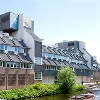 Lipsius
Cleveringaplaats 1, Leiden
-
 Spui Campus
Spui 5, The Hague
-
 Wijnhaven
Turfmarkt 99, The Hague
-
Giant Robots, Big Ideas - Exploring the World of Mecha in Japanese Animation
From towering mechanical heroes to city-destroying battles, giant robots have become one of the most iconic images in Japanese animation. On 28 April 2026, Leiden University will host "Giant Robots, Big Ideas", an afternoon event exploring how these spectacular machines reflect deeper questions about…
-
Onze aarde wordt onleefbaar. Kunnen we het tij nog keren?
We hebben 6 van de 9 grenzen overschreden die bepalen of menselijk leven in de komende generaties nog mogelijk is op aarde. Kunnen we het tij nog keren?
-
Groen licht voor (studenten)woningen in Oegstgeesterdeel
De Universiteit Leiden kan van start met de bouw van 300 studentenwoningen en 500 overige woningen in het Leiden Bio Science Park.
-
Twee onderzoeksprojecten van ISGA krijgen subsidie NWO Open Competitie
In totaal hebben 21 Leidse onderzoekers succesvol een aanvraag ingediend voor de NWO SGW Open Competitie XS. Twee van de beloonde projecten komen van onderzoekers van FGGA: Silvia D’Amato en Jaroslaw Kantorowicz.
-
Working together for a safer workplace - 10 - 14 November inspection of electrical devices
Facility, Organisation
-
Google gift for quantum research
Assistant Professor Vedran Dunjko and his team receive a €100,000 gift from Google to support them in their quantum research. The research focuses on whether quantum computers can provide new ways of understanding the mysteries of high-energy physics. Google is committed to supporting ambitious research…
-
Update: Cleaning robot in the Gorlaeus Building
Facility
-
Pilot with cleaning robot in the Gorlaeus Building
Facility
-
Leiden University researchers receive Vidi grants
The Dutch Research Council (NWO) has awarded Vidi grants to Leiden researchers.
-
 Alexander van Oudenhoven
 -
 Somayah Elsayed
 -
 Marc Molendijk
Faculty of Social and Behavioural Sciences
-
 Janna Houwen
Faculty of Humanities
-
 Mike Preuss
 -
 Hazel Doughty
 -
 Thomas Moerland
 -
‘Moon landers’ measure greenhouse gases in unique agricultural living lab
A huge shiny aluminium object stands in the middle of the Polderlab in Oud Ade. Are the researchers trying to make contact with extraterrestrial life? Certainly not; they are using the ’Moon landers’ to measure whether innovative forms of agriculture reduce greenhouse gas emissions. Fleur van Duin works…
-
Planet in Peril: the relationship between mankind and the planet
What is the relationship between humans and nature like? And how can we use it to tackle climate problems? In the Master Honours Class ‘Planet in Peril’, students approach climate issues from the perspective of the humanities. ‘Things are not always as one-sided as they seem.’
-
Why do a Master Honours Challenge? ‘Step away from your own square millimetre’
Learning how to work with people from different disciplines, that’s what Master Honours Challenges are all about. In teams, students address a challenge for an organisation or society as a whole. Two participants tell us what made their course stand out. ‘It was at times uncomfortable, but exhilarat…
-
Professor argues: ‘Let nature take its course’
Give organisms like plants and animals the freedom to move, interact and meet their own needs, and they will thrive on their own, says Professor Geert de Snoo. Our interference often ends up doing more harm than good.
-
Opinion: AI is taking over our jobs – or is the reality more nuanced?
Following the news that TomTom is cutting 300 jobs due to the use of artificial intelligence (AI), FGGA researchers Friso Selten and Alex Ingrams responded with opinion pieces. They place the news in a broader context and call for a more nuanced debate on AI and job losses.
-
‘Digital services lean heavily on the social infrastructure’
Governments worldwide invest huge sums in their digital services and data strategies. Efficiency and effectiveness are key. But these are not achieved for some people at least, says Professor of Public Policy Sarah Giest. This makes the intended digital inclusion far from inclusive, as she will explain…
-
‘Scientists should be careful when interpreting results of AI models’
Anthropologist Rodrigo Ochigame studies how AI is changing the practice of scientific research. From astrophysics to mathematics to climate science, they find that the adoption of new AI models is raising questions about what counts as reliable scientific evidence.
-
Inventors with a nose for technology
Amidst the lathes and welding machines of the Fine Mechanics Department, Emiel Wiegers is working concentratedly on a metal cylinder. He and his colleagues design and construct components for researchers' set-ups. ‘We are a bunch of inventors who enjoy helping the researchers in our Faculty.’
-
Grants boost collaboration between university and The Hague
How can we make our cities greener and more people-friendly? Two Campus The Hague projects have secured a grant from the Municipality of The Hague. The researchers and students from both projects are working with city residents to find sustainable solutions to local issues.
-
Sustainability Monitor 2023: Leiden University substantially reduces carbon emissions
The Sustainability Monitor 2023 shows that Leiden University is taking its sustainability efforts seriously.
-
From a fossil to an animal skin: as a museum, do you let the original pass through the hands of your visitors, or a replica?
Educators in European science museums sometimes think rather differently about the definition of an 'authentic' object. They think carefully about how they present those objects to teach visitors something or make them curious. This was shown in research by the Science Communication & Society department.…
-
Biology student Sander van Zon: ‘We can still learn so much more about lichens’
Lichens enthusiast Sander van Zon was eager to use his knowledge for his internship. He wrote an excellent thesis on lichens’ biodiversity in the city, of which his first scientific publication will appear soon. With it, he is nominated for the Leiden Science Young Talent Award 2022.
-
Mapping historical marine life: Johannes Müller is researching the history of ecosystems
The underwater world around present-day Indonesia has changed greatly in recent centuries as a result of human activity. University lecturer Johannes Müller has been awarded an NWO XS grant to map the history of the Indonesian ecosystems.
-
Leiden’s poo can help rid patients of resistant gut bacteria
Transferring poo from healthy donors to the intestines of chronically ill people has beneficial effects on these recipients’ gut bacteria, also in the longer term. This is the conclusion of research by the Leiden University Medical Center (LUMC) and the Netherlands Donor Feces Bank (NDFB).