
82 search results for “sun and spelen versie” in the Student website
-
 Yichen Sun
Faculty of Science
-
Jingbo Sun
Faculty of Science
-
 Jiangnan Sun
Faculty of Science
-
 Peng Sun
Faculty of Science
-
Ying Sun
Faculty of Science
-
 Jian Sun
Faculty of Humanities
-
 Shuang Sun
Faculty of Science
-
 Ming Sun
Faculty of Science
-
 Jessie Sun
Faculty of Humanities
-
 Jing Sun
Faculty of Science
-
Is our water older than the sun? Astronomers find clue in ice around young star
A team led by Leiden University in the Netherlands and the National Radio Astronomy Observatory have, for the first time, robustly detected semi-heavy water ice around a young sunlike star. In this ice, some of the ordinary hydrogen atoms have been replaced by deuterium, a heavier variant of hydroge…
-
Room for everyone at a sun-drenched EL CID
Thousands of first-year students and hundreds of mentors kicked off the EL CID on Monday morning. This year for the first time, the introduction week of Leiden University and Leiden University of Applied Sciences was also open for students of Regional Training Centre mboRijnland and the Leiden Instrument…
-
‘The sun is dying out’ as a wake-up call for better science communication
‘Take science communication more seriously.’ This is the message that Ivo van Vulpen, professor by special appointment in Science Communication in Physics, wants to convey during his inaugural lecture. At the moment, a lot of researchers look down their noses at this while it is extremely important…
-
First ring-forming embedded planet discovered around a young sun-like star
Astronomers led by Leiden PhD candidate Richelle van Capelleveen have, for the first time, discovered an exoplanet that has carved a bright gap in the protoplanetary disc around its star. This rare observation provides new insights into how young planets shape their surroundings.
-
around young low-mass star differs fundamentally from one around sun-like star
Using the James Webb Space Telescope, an international team of researchers, including Leiden Professor of Molecular Astrophysics Ewine van Dishoeck, has discovered a palette of hydrocarbons in a planet-forming disc around a young, low-mass star. The results confirm that discs around very lightweight…
-
 University Campus Spui
Spui 5, The Hague
-
Scientists discover the largest stellar black hole in the Milky Way
A European team of astronomers has discovered the largest stellar black hole in the Milky Way. It is more than thirty times as massive as our sun and is located in the constellation of Aquila, about two thousand light-years from Earth. The astronomers stumbled upon the black hole by chance while preparing…
-
This is how astronomers found out how three stars were ejected from star cluster R136
Astronomers led by Simon Portegies Zwart used simulations to reconstruct how three stars were ejected from the star cluster R136, 60,000 years ago. The analysis reveals that five stars were involved in the event in the Tarantula Nebula.
-
Jasper's Day
Jasper Knoester is the dean of the Faculty of Science. How is he doing, what exactly does he do and what does his day look like? In each newsletter, Jasper gives an insight into his life.
-
Gorlaeus rooftop garden: from student project to green meeting spot
On top of the Gorlaeus Building’s bike parking sits a hidden green surprise: Leiden’s largest rooftop garden. Since this academic year, the garden has been open to all students and staff.
-
Mandela Scholarship Fund
Bachelor, Master
-
Dozens of massive stars launched from young star cluster R136
Astronomers have used data from the European Gaia Space Telescope to discover 55 high-speed stars launched from the young star cluster R136 in the Large Magellanic Cloud, a satellite galaxy of the Milky Way. This increases tenfold the number of known “runaway stars” in this region. The team of astronomers,…
-
Electric car batteries can help drive the clean electricity transition
As early as 2030, batteries in electric vehicles could fully meet the need for short-term electricity storage around the world. By connecting them to the power grid they can provide their stored energy, improving energy security and enabling renewable technologies in cleaning the grid.
-
From solar panels to tables made from old jackets: University opens its doors on Heritage Open Days
The theme of the Heritage Open Days Leiden on 10 and 11 September is sustainability. At four University locations guides will talk about the history of the buildings and how they have been renovated. And there is a first: tours in sign language.
-
Outer solar system possibly formed by a passing star
The many thousands of small celestial bodies beyond Neptune’s orbit may have ended up there due to a star that passed close to the solar system billions of years ago. This is shown by Leiden simulation expert Simon Portegies Zwart, along with his German and Dutch colleagues. ‘We are answering several…
-
Evidence of a massive stellar storm on a nearby star
Astronomer Joseph Callingham and his team have observed for the first time a clear signal from a giant burst from a star outside our solar system. This would have a devastating impact on any unfortunate planet orbiting the star.
-
Planet found too big for its parent star
The discovery of a planet far too large for its sun defies models about the formation of solar systems and planets. In a paper in Science, researchers, including Yamila Miguel of Leiden Observatory, report the discovery of a planet more than 13 times heavier than Earth orbiting the ultracool dwarf star…
-
For the first time, astronomers witness the dawn of a new solar system
International researchers have, for the first time, pinpointed the moment when planets began to form around a star beyond the Sun. Using the ALMA telescope, in which the European Southern Observatory (ESO) is a partner, and the James Webb Space Telescope, they have observed the creation of the first…
-
Many playgrounds unsuitable for children with autism
Playgrounds often fail to accommodate children with autism, according to researchers Carolien Rieffe and colleagues. They have published an essay offering practical advice on how to make all children feel safe and welcome for Autism Week (Dutch) and World Autism Autism Awareness/ Acceptance Day on 2…
-
 Wijnhaven
Turfmarkt 99, The Hague
-
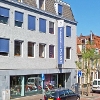 Plexus Student Centre
Kaiserstraat 25, Leiden
-
No matter the weather: honours students explore the 'wilderness' in Wassenaar
With a combination of incidental sunshine, torrential rain, and wind chills, weather conditions were not ideal for a hiking excursion. Even so, last Saturday, honours students braved a trek across an estate and a golf club in Wassenaar to learn about the relationship between gardens and nature. From…
-
Measuring the pull of gravity on a micron-sized particle
Tjerk Oosterkamp of the Leiden Institute of Physics managed to do the first-ever measurement of gravity on a tiny particle - just 0.43 milligrams - where the quantum regime starts. He explains in Physics World why this is so challenging.
-
Honorary doctorate for Canadian-American astrophysicist Sara Seager
Leiden University will confer an honorary doctorate on astrophysicist Sara Seager for her work on exoplanets.
-
Last starlight for space telescope Gaia
ESA’s space telescope Gaia, which maps the Milky Way, completes its active phase of scanning the sky on 15 January. Over the past decade, Gaia has made more than three trillion observations of about two billion stars and other cosmic objects. ‘Gaia is already the discovery machine of the decade,’ Leiden…
-
Star birth: a slow and mysterious drama
A star does not just appear in the sky overnight. Its creation takes tens of thousands of years. Twenty years ago, astronomers took a picture of a star in its birth phase. The James Webb Space Telescope (JWST) could now capture that same star in much greater detail. This does not only provide beautiful…
-
Stunning James Webb images show birth and death of massive stars
The James Webb Space Telescope continues to surprise us with stunning pictures, but of what exactly? Astronomer Nienke van der Marel shows with three images how massive stars lead short but explosive lives.
-
Finding the origin of giant black holes
‘Space Antenna LISA will open an unprecedented window on the Universe,’ says astronomer Elena Maria Rossi. The mission will be the first one to detect Gravitational Waves from space. These can tell us more about the beginning of our Universe and the formation of black holes. With an NWO grant of twelve…
-
Celebrating female computer scientists: ‘Computer science is for everyone’
Four female computer scientists share a common goal: to showcase the significant contributions of women in computer science and inspire their students. Together, they are organising this year’s Alice & Eve event, a one-day symposium dedicated to celebrating women in computer science. The event, scheduled…
-
Young Star Renske Donkers: how is she doing now?
How is Young Star Renske Donkers doing now? Early this year she was the second person ever to win the Young Star Award for the best bachelor student. After her bachelor Molecular Science & Technology, Renske is now busy with her master Chemical Process Engineering in Delft. ‘This award was a great boost…
-
Jasper's Day
Jasper Knoester is the dean of the Faculty of Science. How is he doing, what exactly does he do and what does his day look like? In each newsletter, Jasper gives an insight into his life.
-
Astronomers spot benzene in planet-forming disk around star for first time
An international team of astronomers including Leiden professor Ewine van Dishoeck has observed the benzene molecule (C6H6) in a planet-forming disk around a young star for the first time. The observations tell us more about the forming of planets in this disc, like our own Earth. The scientists publish…
-
From Leiden to Harvard: four questions for Julia Santos
Eight early-career researchers from around the world have been awarded a 51 Pegasi b Fellowship – a prestigious opportunity for astronomers. Julia Santos, a PhD candidate at Leiden Observatory, is one of them. We asked her four questions about this remarkable fellowship.
-
Webb data suggest potential atmosphere around rocky exoplanet
Researchers using NASA’s James Webb Space Telescope may have detected atmospheric gases surrounding 55 Cancri e, a hot rocky exoplanet 41 light-years from Earth. This is the best evidence to date for the existence of any rocky planet atmosphere outside our solar system.
-
What tiny isotopes reveal about planets outside our solar system
Planets existing in other solar systems contain invaluable information about the origin of planets and life. PhD candidate Yapeng Zhang has studied their atmospheres by looking at their smallest parts: isotopes. With her research she hopes to discover what makes our own solar system unique.
-
Jasper's Day
Jasper Knoester is the dean of the Faculty of Science. How is he doing? What kinds of things is he doing and what does his day look like? In each newsletter Jasper gives a peek into his life as dean.
-
Rare isotopes in our neighbouring stars provide new insights in the origin of carbon and oxygen
Astronomers at Leiden University have detected rare isotopes of carbon and oxygen in our neighbouring stars for the first time, providing a new window to better understand the chemical evolution of the cosmos.The results are published today in the journal Nature Astronomy.
-
James Webb Space Telescope sees sand clouds on 'cotton candy planet' WASP-107b
A team of European astronomers has found a silicate-based weather system on a cloudy gas planet around the star WASP-107. It is the first time astronomers have found silicate clouds and rain. They also conclude that temperatures deeper in the atmosphere are rising rapidly. 'The presence of clouds has…
-
Astronomers and surgeons join forces in the operating theatre
Astronomers and surgeons from Leiden are collaborating with industry to develop an optical instrument that delivers faster, more accurate imaging of tumour tissue and abnormal blood flow during surgery.
-
A+ for Leiden astronomy student who simulated chaotic interactions of black holes
Leiden astronomy Master's student Arend Moerman has received an A+ for his thesis research on the simulation of chaotic interactions of three black holes. The simulations, which he carried out together with his Leiden and Oxford colleagues, show that lighter black holes tend to slingshot each other…