
135 search results for “sun and strw visser” in the Student website
-
Mandela Scholarship Fund
Bachelor, Master
-
 Spui Campus
Spui 5, The Hague
-
Beehive Student Centre
Spui 5, The Hague
-
Dozens of massive stars launched from young star cluster R136
Astronomers have used data from the European Gaia Space Telescope to discover 55 high-speed stars launched from the young star cluster R136 in the Large Magellanic Cloud, a satellite galaxy of the Milky Way. This increases tenfold the number of known “runaway stars” in this region. The team of astronomers,…
-
Electric car batteries can help drive the clean electricity transition
As early as 2030, batteries in electric vehicles could fully meet the need for short-term electricity storage around the world. By connecting them to the power grid they can provide their stored energy, improving energy security and enabling renewable technologies in cleaning the grid.
-
Lianas are taking over the rainforests – and it’s visible from space
A pandemic of lianas is sweeping through tropical forests, reducing their ability to store carbon and limiting their role in mitigating climate change. Two recent studies from Leiden University highlight the issue. ‘We now understand why lianas are visible in satellite imagery.’
-
‘Wetenschapswonders’ brings science to life for primary school pupils in Leiden
On 17 June, primary school pupils in Leiden will get the chance to explore science in an interactive and engaging way. The exciting new show ‘Wetenschapswonders’ is the initiative of master’s students Boele Visser and Ilse Hordijk, from the Rino Foundation. ‘I’m happy to help build a bridge between…
-
 Mirko Forastiere
 -
 Manuela Rueda Trujillo
 -
 Michiel Smit
Faculteit der Rechtsgeleerdheid
-
Biology students expose exotic amphibians in the dunes
During the spring of 2021, a group of eight biology students from Leiden set out into the dunes in search of amphibians. Using DNA, they determined the geographic origin of the animals. And guess what? In many cases they discovered exotic populations of animals that do not naturally belong in The Netherlands.…
-
Cosmic magnifying glass reveals exceptionally heavy dormant black hole in the early universe
Astronomers have measured the mass of a dormant, supermassive black hole in the early universe for the first time. Thanks to a combination of the James Webb Space Telescope and a natural cosmic magnifying glass, researchers were able to weigh the black hole directly based on its gravity.
-
From solar panels to tables made from old jackets: University opens its doors on Heritage Open Days
The theme of the Heritage Open Days Leiden on 10 and 11 September is sustainability. At four University locations guides will talk about the history of the buildings and how they have been renovated. And there is a first: tours in sign language.
-
Outer solar system possibly formed by a passing star
The many thousands of small celestial bodies beyond Neptune’s orbit may have ended up there due to a star that passed close to the solar system billions of years ago. This is shown by Leiden simulation expert Simon Portegies Zwart, along with his German and Dutch colleagues. ‘We are answering several…
-
Evidence of a massive stellar storm on a nearby star
Astronomer Joseph Callingham and his team have observed for the first time a clear signal from a giant burst from a star outside our solar system. This would have a devastating impact on any unfortunate planet orbiting the star.
-
Planet found too big for its parent star
The discovery of a planet far too large for its sun defies models about the formation of solar systems and planets. In a paper in Science, researchers, including Yamila Miguel of Leiden Observatory, report the discovery of a planet more than 13 times heavier than Earth orbiting the ultracool dwarf star…
-
For the first time, astronomers witness the dawn of a new solar system
International researchers have, for the first time, pinpointed the moment when planets began to form around a star beyond the Sun. Using the ALMA telescope, in which the European Southern Observatory (ESO) is a partner, and the James Webb Space Telescope, they have observed the creation of the first…
-
News but nothing new: many pesticides in Dutch swimming and natural waters
There has been a lot of media attention for the report recently completed by the Institute of Environmental Sciences (CML) from Leiden University. However, it has long been known that Dutch surface water contains too many toxic pesticides. ‘We will have to improve our ways of life together with many…
-
A cocktail of chemicals in surface water is more toxic than each substance individually
Pesticides can form a toxic cocktail when they occur in combination in surface water. This is the finding of research that Leiden University and the Dutch National Institute for Public Health and the Environment (RIVM) presented on Monday 14 October. The Dutch Ministry of Infrastructure and Water Management…
-
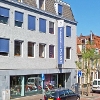 Plexus Student Centre
Kaiserstraat 25, Leiden
-
These scientists will lead the Science strategic research themes
Zes onderzoekers zijn voor twee jaar aangesteld als themaleider voor de onderzoeksthema's van de faculteit Wiskunde en Natuurwetenschappen.
-
No matter the weather: honours students explore the 'wilderness' in Wassenaar
With a combination of incidental sunshine, torrential rain, and wind chills, weather conditions were not ideal for a hiking excursion. Even so, last Saturday, honours students braved a trek across an estate and a golf club in Wassenaar to learn about the relationship between gardens and nature. From…
-
Measuring the pull of gravity on a micron-sized particle
Tjerk Oosterkamp of the Leiden Institute of Physics managed to do the first-ever measurement of gravity on a tiny particle - just 0.43 milligrams - where the quantum regime starts. He explains in Physics World why this is so challenging.
-
Honorary doctorate for Canadian-American astrophysicist Sara Seager
Leiden University will confer an honorary doctorate on astrophysicist Sara Seager for her work on exoplanets.
-
Why we need to look underwater to understand our past
Traces of the past remain hidden in rivers, lakes and seas. In his inaugural lecture Martijn Manders will explain why underwater archaeology is important to understanding our history.
-
Improving the environment of people with dementia with the help of new software
Can we improve the living environment of people with dementia with software and smartwatches? Daniela Gawehns did research in a care facility for people with dementia as part of the project 'Dementia back in the heart of society'. This way, she tried to find out whether an open living environment leads…
-
Last starlight for space telescope Gaia
ESA’s space telescope Gaia, which maps the Milky Way, completes its active phase of scanning the sky on 15 January. Over the past decade, Gaia has made more than three trillion observations of about two billion stars and other cosmic objects. ‘Gaia is already the discovery machine of the decade,’ Leiden…
-
Stunning James Webb images show birth and death of massive stars
The James Webb Space Telescope continues to surprise us with stunning pictures, but of what exactly? Astronomer Nienke van der Marel shows with three images how massive stars lead short but explosive lives.
-
Star birth: a slow and mysterious drama
A star does not just appear in the sky overnight. Its creation takes tens of thousands of years. Twenty years ago, astronomers took a picture of a star in its birth phase. The James Webb Space Telescope (JWST) could now capture that same star in much greater detail. This does not only provide beautiful…
-
Astronomers spot benzene in planet-forming disk around star for first time
An international team of astronomers including Leiden professor Ewine van Dishoeck has observed the benzene molecule (C6H6) in a planet-forming disk around a young star for the first time. The observations tell us more about the forming of planets in this disc, like our own Earth. The scientists publish…
-
Jasper's Day
Jasper Knoester is the dean of the Faculty of Science. How is he doing, what exactly does he do and what does his day look like? In each newsletter, Jasper gives an insight into his life.
-
Young Star Renske Donkers: how is she doing now?
How is Young Star Renske Donkers doing now? Early this year she was the second person ever to win the Young Star Award for the best bachelor student. After her bachelor Molecular Science & Technology, Renske is now busy with her master Chemical Process Engineering in Delft. ‘This award was a great boost…
-
Finding the origin of giant black holes
‘Space Antenna LISA will open an unprecedented window on the Universe,’ says astronomer Elena Maria Rossi. The mission will be the first one to detect Gravitational Waves from space. These can tell us more about the beginning of our Universe and the formation of black holes. With an NWO grant of twelve…
-
Celebrating female computer scientists: ‘Computer science is for everyone’
Four female computer scientists share a common goal: to showcase the significant contributions of women in computer science and inspire their students. Together, they are organising this year’s Alice & Eve event, a one-day symposium dedicated to celebrating women in computer science. The event, scheduled…
-
From Leiden to Harvard: four questions for Julia Santos
Eight early-career researchers from around the world have been awarded a 51 Pegasi b Fellowship – a prestigious opportunity for astronomers. Julia Santos, a PhD candidate at Leiden Observatory, is one of them. We asked her four questions about this remarkable fellowship.
-
A suitcase containing quantum inspiration on a trip across Europe: ‘We gained new insights’
A suitcase as a messenger of quantum science. That is the idea behind QuanTour, a project connecting researchers from 12 European universities. In December, the suitcase landed in Leiden. A month later, it is time to pass the baton to Copenhagen. But what happened to it in Leiden?
-
Leiden University and Municipality of The Hague to collaborate on sustainability
Leiden University and the Municipality of The Hague signed a collaboration agreement on sustainability on 1 November. Their main goals are to build a network, share knowledge and explore the possibilities of a Climate Centre for the people of The Hague.
-
Grants for fundamental research in Leiden
Three fundamental research projects at Leiden in physics, chemistry and medical science have received funding from the Dutch Research Council (NWO). They involve research on magnetic fields in the universe, the role of myeloid cells in cancer immunotherapy and the evolution of ancient proteins.
-
Webb data suggest potential atmosphere around rocky exoplanet
Researchers using NASA’s James Webb Space Telescope may have detected atmospheric gases surrounding 55 Cancri e, a hot rocky exoplanet 41 light-years from Earth. This is the best evidence to date for the existence of any rocky planet atmosphere outside our solar system.
-
NWO funding for five FWN projects within the Dutch Research Agenda
Can humans perceive single photons? What is our place in the universe? How can we make quantum computers more stable? Five researchers from the Faculty of Science have received funding for their research projects within the Dutch Research Agenda (NWA).
-
Astronomy on Tap
Lecture, Astronomy on Tap
-
Astronomy on Tap
Lecture, Astronomy on Tap
-
What tiny isotopes reveal about planets outside our solar system
Planets existing in other solar systems contain invaluable information about the origin of planets and life. PhD candidate Yapeng Zhang has studied their atmospheres by looking at their smallest parts: isotopes. With her research she hopes to discover what makes our own solar system unique.
-
Astronomers and surgeons join forces in the operating theatre
Astronomers and surgeons from Leiden are collaborating with industry to develop an optical instrument that delivers faster, more accurate imaging of tumour tissue and abnormal blood flow during surgery.
-
Jasper's Day
Jasper Knoester is the dean of the Faculty of Science. How is he doing? What kinds of things is he doing and what does his day look like? In each newsletter Jasper gives a peek into his life as dean.
-
Rare isotopes in our neighbouring stars provide new insights in the origin of carbon and oxygen
Astronomers at Leiden University have detected rare isotopes of carbon and oxygen in our neighbouring stars for the first time, providing a new window to better understand the chemical evolution of the cosmos.The results are published today in the journal Nature Astronomy.
-
James Webb Space Telescope sees sand clouds on 'cotton candy planet' WASP-107b
A team of European astronomers has found a silicate-based weather system on a cloudy gas planet around the star WASP-107. It is the first time astronomers have found silicate clouds and rain. They also conclude that temperatures deeper in the atmosphere are rising rapidly. 'The presence of clouds has…
-
Binary star reveals: planet formation doesn’t always happen in sync
A team of international researchers led by Tomas Stolker in the Netherlands has imaged a young gas giant exoplanet near a 12-million-year-old star. The planet is orbiting a star at which planet formation has finished, while the same-aged companion star still has a planet-forming disk. The researchers…
-
A+ for Leiden astronomy student who simulated chaotic interactions of black holes
Leiden astronomy Master's student Arend Moerman has received an A+ for his thesis research on the simulation of chaotic interactions of three black holes. The simulations, which he carried out together with his Leiden and Oxford colleagues, show that lighter black holes tend to slingshot each other…
-
Two planets-in-formation discovered around young star WISPIT 2
In the disk surrounding the young star WISPIT 2, not one but two planets are taking shape. Leiden PhD candidate Richelle van Capelleveen played a key role in this discovery, providing a rare glimpse into the early stages of planetary system formation.