383 search results for “says” in the Student website
-
Exhibition encourages us to reflect on the history of slavery
What is the significance of the history of slavery for our present-day society? A special exhibition in the inner courtyard of the Academy Building features eleven insightful portraits of students and staff, and their answer to this question. The aim of the exhibition’s initiators is to make the subject…
-
Unique exhibition translates science into music, images and dance
Leiden researchers from different disciplines look together at complex social problems. What happens when they join forces with artists? The results could be seen on Tuesday 11 June during a unique exhibition. Take a look for yourself:
-
Sneak preview: from department store to university building
Just a stone’s throw from Binnenhof, the heart of Dutch politics, Spui Campus will open its doors in early 2026. Join us for a sneak preview.
-
Polish Holocaust researchers accused of defamation will give Cleveringa Lecture
On 26 November historian Jan Grabowski and sociologist Barbara Engelking will both give the Cleveringa Lecture. They wrote a book about the Holocaust in Poland and were taken to court for defamation.
-
Zelensky addresses students: 'Live your own life, but do so together with others'
A standing ovation. A wave and a smile from the president. A final selfie. Ukrainian President Volodymyr Zelensky addressed students in the Netherlands for the first time on Tuesday morning via a livestream in The Hague. He did so in front of two packed lecture halls at both Leiden University and The…
-
The Nuance Project: Respectful dialogue about sensitive topics give students hope
Students from Leiden University have launched The Nuance Project, a platform for respectful, open-minded dialogue on divisive issues. The aim is to foster connection and understanding among people even if their viewpoints differ.
-
Zeineb Romdhane: Student and Minister for New Democracy
A shadow cabinet has just been formed. This one consists of students from all the Dutch universities. They will be keeping politicians on their toes in the coming year, and want to show that progress cannot be made without academic research and teaching. Master’s student Zeineb Romdhane is Minister…
-
Plants and planets
The Plants & Planets exhibition brings two worlds together in a dazzling mix of science, nature and art. It opens at Old Observatory Leiden and Hortus botanicus on 7 February.
-
A platform for a complex conflict: ‘Friction is good’
Yousef Sweid was called a ‘stinking Arab’ in the sandpit at his Jewish kindergarten in Haifa. In a packed lecture hall, the Palestinian-Israeli actor performed a powerful excerpt from his show ‘Between the River and the Sea’.
-
Honours Class reconciles students with the unpredictability of life
The course Designing Your Life helps students navigate their career pathways. As it turns out, these pathways are full of twists and turns and - as with many journeys - you only make progress once you gather the courage to take the first step.
-
Share in the chair at the [s]TATTOO studio – and leave with a personal artwork
We often feel at ease in a salon chair, and the conversation soon starts to flow. That feeling will be recreated in the coming weeks in the [s]TATTOO pop-up studio. Students and staff can share their thoughts, feelings or worries – and will leave with an artwork based on their story.
-
So long, Gravensteen: ‘History dripped off the walls’
Historic and iconic yet expensive and cold. It’s with mixed feelings that the university is leaving the Gravensteen building, which dates back to the 12th century. How was it to work and study in this former Leiden prison?
-
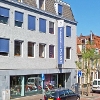 Plexus Student Centre
Kaiserstraat 25, Leiden
- Forgotten heroes
-
Mandela Scholarship Fund
Bachelor, Master
-
After graduation
You’ve graduated. What’s your next step? Leiden University offers many options for students who have just finished their Bachelor’s or Master’s degree.
-
Month of Tutankhamun: Egypt's most legendary pharaoh
November marks exactly 100 years since the discovery of Tutankhamun's tomb. To celebrate this special discovery, the Faculty of Humanities, together with various parties, is organising the 'Month of Tutankhamun': a month full of activities around Egypt's most legendary pharaoh.
-
Nominees for the 2025 Leiden Teaching Prize
Which teacher knows best how to inspire their students? Carmen van den Bergh (Humanities), Egbert Koops (Law) and Arjan Louwen (Archaeology) have been nominated for the 2025 Leiden Teaching Prize.
-
These are the nominees for the Leiden Teaching Prize 2023
Paul Gobée (LUMC), Kirsty Rolfe (Humanities) and Frank Takes (Science) have been nominated for the Leiden Teaching Prize 2023.
-
Support the Ukrainian and Russian students in Leiden and The Hague
The Russian invasion of Ukraine has also had dramatic consequences for Ukrainian students at Leiden University. Besides their intense concern about the fate of family and friends, they also face major financial problems. This also applies to Russian students who can no longer access their bank accounts.…
-
Leiden University joins national 113 campaign: ‘It’s okay to feel uncomfortable about talking about suicide’
Talking about suicide is important, but anything but comfortable. To make this difficult subject easier for students and staff to discuss, the university is organising a campaign week in line with the national campaign ‘1K Z1E J3’ (I see you) being run by Stichting 113 Zelfmoordpreventie (113 is the…
-
Students become ‘change agents’ in Sustainability Challenge
Leiden students working to solve a sustainability problem at the request of an external party: that is the Sustainability Challenge. During a recent symposium, 28 groups of four to five students unveiled their solutions. The commisioners expressed great enthusiasm.
-
Student Jesper: personal and social entrepreneurship
Jesper van Loon, a second-year Bio-Pharmaceutical Sciences student, is a fully fledged entrepreneur. He was still a minor when he and his school friend Max started their own business, BLIJLES Bollenstreek, which has now expanded to the Midden-Holland and Haarlemmermeer areas. ‘This is what I want, but…
-
What do you do if your professor winks at you?
Sexual harassment was the theme of the recent annual symposium of student ambassadors to the Leiden-Bollenstreek police in collaboration with the police and the municipality. An extremely important issue to students − if the 100 places being claimed as soon as the symposium was announced was anything…
-
Deans celebrate ten years Honours Academy: ‘We are educating people who can make a difference’
The Honours Academy celebrates its tenth anniversary. How did the institute develop over time, and what are aspirations for the future? We speak with the current Dean and a predecessor who was there at the Academy's founding. A conversation about identity, inspiration, and impact ensues. ‘It is about…
-
Exploring educational experiments: pass/fail and ‘unessays’ at Honours College Law
How to innovate education? In this series, the Honours Academy highlights examples from their educational testing ground that aim to inspire. Today: the liberating effect of pass/fail and ‘unessays’ at Honours College Law.
-
Passionate debate on university’s fossil fuel ties
Should Leiden University cut its ties with the fossil fuel industry forthwith? This was the main question in a debate between students and staff. The answer was clearer for some than for others.
-
Pride is a celebration, but also a fight for visibility
‘Be yourself. Be as gay, queer, trans as you can and show the world you exist.’ These rousing words from Looi van Kessel marked the start of the third Pride Leiden for the university boat, with the theme: ‘450 years of being yourself’.
-
Leiden University starts dismissal procedure against professor on the grounds of unacceptable behaviour
A professor from Leiden University, together with a former employee (who is also the professor’s partner), has been guilty of long-term unacceptable and often transgressive behaviour in the form of abuse of power and manipulation. This behaviour led to a culture of fear among staff who were largely…
-
'If Asia doesn't work out, I'll go to Sweden'
It was a busy turn-out at the first Study Abroad Festival held recently at the Gorlaeus Laboratory on 30 October 2015. Students gathered here to orient themselves - albeit often in an early phase - on studies or work placements abroad.
-
Interview with Rector Hester Bijl: ‘There is no place for antisemitism here’
Leiden University is under fire: it is allegedly doing too little to tackle antisemitism. Rector Hester Bijl responds to this accusation and to a video from 2014 on social media in which extreme remarks are made. ‘We can be short about such comments: they are unacceptable. The university is and always…
-
Hallo Hofstad! Eerstejaars maken vliegende start in Den Haag
Struinen in het historische centrum, de faculteit ontdekken en natuurlijk chillen aan het strand. Honderden eerstejaars leren in de HOP-week elkaar en hun nieuwe stad kennen. Voor veel studenten is de week een 'gamechanger'.
-
Tazuko van Berkel new member The Young Academy
The Young Academy has gained a new Leiden humanities scholar as a member. University lecturer Greek language and literature Tazuko van Berkel will be appointed as a member as of March.
-
Part-time work in schools: ‘Students get to see how great teaching really is’
Given the teacher shortage, secondary schools could use an extra pair of hands. Alfrink College in Zoetermeer is glad to have students from the university helping out in class. ‘We hope students will see how great it is to work in teaching.’
-
Thousands of new students start an old-style EL CID
Smiling faces, a mass dance and a bit of awkwardness: after two ‘corona editions’ of EL CID, the Leiden introduction week is back with a vengeance this year. A total of 3,412 first-year students from Leiden University and University of Applied Sciences Leiden, accompanied by 486 mentors, started EL…
-
Court deems unacceptable behaviour by professor likely, ruling on dismissal request postponed
It is sufficiently plausible that the professor from the Faculty of Archaeology exhibited the ‘inappropriate and unacceptable behaviour’ detailed in the advice of the investigating committee. That is is unless the professor provides counter-evidence. This is the conclusion of the Subdistrict Court…
-
What the Leiden Teaching Prize has meant for three past winners
You win the Leiden Teaching Prize and suddenly all eyes are on you. Three past recipients reflect on how this student-awarded prize has changed how they work and improved their teaching – and how they chose to spend the money.
-
University elections: vote now!
Your vote for the University and Faculty Council counts! The councils play an important role at the university. To vote click on the link in the right-hand column. Cast your vote by Friday 21 May, 16.00.
-
Digital education: what’s working well and what can we improve?
Nearly a year since the abrupt switchover to mostly online learning, the Digital Education seminar gave teaching staff the opportunity to review their experiences. What can stay in 2021 and what must go? Frequently voiced opinions: yes please to digital tools that make lectures more interactive; yes…
-
Field trip to sustainable farm shows ‘what you can achieve if you chart your own path’
How to take ownership of your career? To find out, students from ‘Design Your Career as a Climate Change Maker’ visited a farmer who has done just that. They learned from him that it’s never too late to start working on something you believe in.
-
A Dutch Robespierre? Dissertation sheds new light on Leiden revolutionary Pieter Vreede
Leiden patriot Pieter Vreede fought for greater popular influence. Historian Dirk Alkemade reveals how this pioneer used radical means to shape Dutch democracy.
-
Queen Máxima talks to students in Leiden about mental health
How do you know if your idea has succeeded? The Queen coming to call a year and a half later might just be a clue. This happened to the Leiden student foundation ‘Door Het Geluid’, which promotes student well-being.
-
Leideners and researchers learn from each other at the Science Market
3 October University has become something of a tradition: a bit of science among the Leidens Ontzet celebrations. During the new and improved edition, the WetenschapsWarenMarkt (Science Market), visitors spoke to researchers about the nitrogen problem, making organs and the city’s connections with A…
-
Student and entrepreneur: ‘PLNT The Hague is the place to find like-minded people’
Taking a Bachelor’s in Security Studies while starting and running two businesses: student Mohamed Sulaiman never stops. But he wouldn’t have it any other way. PLNT The Hague entrepreneurs’ hub is a source of help and inspiration.
-
Got a question about science? Ask Leiden!
Due to its success, the Leiden2022 Q&A has been extended and is looking for even more thought-provoking, interesting or unusual questions.
-
Students, staff and alumni to share the stage at Leiden Canal Concert
Music lovers are welcome at this free open-air concert celebrating 450 years of Leiden University, on Sunday 6 July. This special jubilee edition of the Rapenburg Canal Concert will feature a unique orchestra made up of our students, staff and alumni, performing on a floating stage.
-
Leiden students develop AI tool for marking assignments
Jeroen van Gessel’s lecturers didn’t always have time for extensive feedback on his written assignments. So, together with tech-savvy friend Menno Hahury, he founded Eduface, a startup to develop an AI teaching assistant. ‘The first users now work three times faster.'
-
Purple Friday: ‘I try to give the community some support’
Purple clothing and a pride flag flying from all University buildings: Leiden University is once again taking part in Purple Friday. How do people experience this day? We asked some employees and students of the Faculty of Humanities.
-
National ThinkTank: ‘A school trip that never ends’
The clever young people at the National ThinkTank who tackle an urgent societal problem each year include two Leiden alumni this autumn: Jiao Harmsen and Jort van Dalen. They will spend at least four months getting to grips with the topic of ‘education’.
-
A more sustainable Leiden through citizen science
In the Leiden Municipality Challenge, 25 students investigated how Leiden could become more sustainable. In doing so, they enlisted the help of the city's citizens. 'When citizens themselves participate in the research process, they have a better understanding of how science works.'