221 search results for “sun and strw visser” in the Student website
-
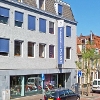 Plexus Student Centre
Kaiserstraat 25, Leiden
-
These scientists will lead the Science strategic research themes
Zes onderzoekers zijn voor twee jaar aangesteld als themaleider voor de onderzoeksthema's van de faculteit Wiskunde en Natuurwetenschappen.
-
Update on works at the Agora: installation of barrier fencing
Facility
-
Highlights of 2025 at Leiden Law School
2025 was a year to remember at our faculty. We celebrated our 450th anniversary, launched new degree programmes and welcomed many inspiring speakers, yet we also felt the weight of budget constraints. Our year in a nutshell:
-
No matter the weather: honours students explore the 'wilderness' in Wassenaar
With a combination of incidental sunshine, torrential rain, and wind chills, weather conditions were not ideal for a hiking excursion. Even so, last Saturday, honours students braved a trek across an estate and a golf club in Wassenaar to learn about the relationship between gardens and nature. From…
-
Measuring the pull of gravity on a micron-sized particle
Tjerk Oosterkamp of the Leiden Institute of Physics managed to do the first-ever measurement of gravity on a tiny particle - just 0.43 milligrams - where the quantum regime starts. He explains in Physics World why this is so challenging.
-
Honorary doctorate for Canadian-American astrophysicist Sara Seager
Leiden University will confer an honorary doctorate on astrophysicist Sara Seager for her work on exoplanets.
-
DNA from a cup of pond water can reveal a lot: Kat Stewart will find out with a Vidi grant from NWO
She has had the idea for seven years, but now environmental scientist and conservation biologist Kat Stewart finally gets to work on it. She has been awarded a Vidi grant by NWO to find out how DNA from water can be used to shed light on invasive species and their impact on native populations.
-
Why we need to look underwater to understand our past
Traces of the past remain hidden in rivers, lakes and seas. In his inaugural lecture Martijn Manders will explain why underwater archaeology is important to understanding our history.
-
Documentary offers unique insight into the work of juvenile court judges
The documentary ‘De Stem van het Kind’ (The Voice of the Child) gives an impressive insight into the work of juvenile court judges. Documentary maker Pieter Fleury, Professor of Children’s Rights Ton Liefaard and juvenile court judge Johan Visser worked together for the past seven years to make the…
-
Leiden Law Op 1 marks the start of a new and innovative academic year
On Tuesday 6 September, the faculty year 2022-2023 got off to a great start with Leiden Law Op 1, our yearly talkshow live from the Kamerlingh Onnes Gebouw. Together with the Faculty Board, academic staff and students, we looked ahead to the upcoming academic year.
-
Summer filled with conferences in Leiden
It will be a summer filled with conferences at the Faculty of Humanities in Leiden. In the coming months, there will be something for everyone at the university, especially in the field of languages and cultures of Africa and the Middle East.
-
Improving the environment of people with dementia with the help of new software
Can we improve the living environment of people with dementia with software and smartwatches? Daniela Gawehns did research in a care facility for people with dementia as part of the project 'Dementia back in the heart of society'. This way, she tried to find out whether an open living environment leads…
-
Last starlight for space telescope Gaia
ESA’s space telescope Gaia, which maps the Milky Way, completes its active phase of scanning the sky on 15 January. Over the past decade, Gaia has made more than three trillion observations of about two billion stars and other cosmic objects. ‘Gaia is already the discovery machine of the decade,’ Leiden…
-
3 October University: from Russian DNA to drug-related violence
In prehistoric times there was a huge wave of migration, from the steppes in Russia and Ukraine to West Europe. The newcomers’ genes began to dominate. Archaeology research in Leiden into burial mounds in the Veluwe and Utrechtse Heuvelrug areas of the Netherlands yielded this spectacular conclusion.…
-
Homo erectus discovery in Indonesia features in news stories world wide
The Leiden archaeologist Harold Berghuis was closely involved in archaeological discoveries off the coast of Java. Skull fragments and other fossil remains provide new insights into the world of Homo erectus. The discovery was the subject of numerous news reports.
-
Researcher teaching in the classroom: ‘We need to imitate nature more closely’
How can we supply the growing world population with sustainable energy? At Laurens College in Rotterdam, Prof. Marc Koper speaks with the students about the crucial role of chemistry in the energy transition. Guest classes like this are a good way for school students to learn about the academic world,…
-
Stunning James Webb images show birth and death of massive stars
The James Webb Space Telescope continues to surprise us with stunning pictures, but of what exactly? Astronomer Nienke van der Marel shows with three images how massive stars lead short but explosive lives.
-
Star birth: a slow and mysterious drama
A star does not just appear in the sky overnight. Its creation takes tens of thousands of years. Twenty years ago, astronomers took a picture of a star in its birth phase. The James Webb Space Telescope (JWST) could now capture that same star in much greater detail. This does not only provide beautiful…
-
Astronomers spot benzene in planet-forming disk around star for first time
An international team of astronomers including Leiden professor Ewine van Dishoeck has observed the benzene molecule (C6H6) in a planet-forming disk around a young star for the first time. The observations tell us more about the forming of planets in this disc, like our own Earth. The scientists publish…
-
Jasper's Day
Jasper Knoester is the dean of the Faculty of Science. How is he doing, what exactly does he do and what does his day look like? In each newsletter, Jasper gives an insight into his life.
-
Spinoza Prize for astrophysicist Ignas Snellen
With his clever measuring methods Ignas Snellen – together with his team – was the first to detect carbon monoxide in the atmosphere of exoplanets. For his pioneering work the Leiden astrophysicist has been awarded the Spinoza Prize, the highest academic honour in the Netherlands. The prize of 2.5 million…
-
Archaeologists in action: stories from the field
During the summer, staff and students of the Faculty of Archaeology travel to all parts of the world, initiating or joining fieldwork projects. Read some of our students' stories here!
-
Young Star Renske Donkers: how is she doing now?
How is Young Star Renske Donkers doing now? Early this year she was the second person ever to win the Young Star Award for the best bachelor student. After her bachelor Molecular Science & Technology, Renske is now busy with her master Chemical Process Engineering in Delft. ‘This award was a great boost…
-
Finding the origin of giant black holes
‘Space Antenna LISA will open an unprecedented window on the Universe,’ says astronomer Elena Maria Rossi. The mission will be the first one to detect Gravitational Waves from space. These can tell us more about the beginning of our Universe and the formation of black holes. With an NWO grant of twelve…
-
Celebrating female computer scientists: ‘Computer science is for everyone’
Four female computer scientists share a common goal: to showcase the significant contributions of women in computer science and inspire their students. Together, they are organising this year’s Alice & Eve event, a one-day symposium dedicated to celebrating women in computer science. The event, scheduled…
-
Snacks, drinks, poster presentations: Education Market inspires teachers
On Thursday 19 June, the sun-drenched garden of the Huizinga Building was the setting for the Education Market. Over snacks and drinks, colleagues inspired each other with educational innovations.
-
Students and employees celebrate 450th anniversary at sunny LAWLANDS
On 19 June, the grounds of the Kamerlingh Onnes Building were transformed into LAWLANDS! It had everything: sun, music, science, beach, games, quizzes and, above all, an enthusiastic audience of staff and students.
-
Throwback to the End of the Academic Year Event on May 8: good food and good company
On May 8, the Faculty of Archaeology celebrated its yearly End of Academic Year Event. The event was a chance for staff and students to mingle, while enjoying a nice meal together.
-
From Leiden to Harvard: four questions for Julia Santos
Eight early-career researchers from around the world have been awarded a 51 Pegasi b Fellowship – a prestigious opportunity for astronomers. Julia Santos, a PhD candidate at Leiden Observatory, is one of them. We asked her four questions about this remarkable fellowship.
-
Leiden and African students share knowledge and experiences in online Global Health course
Online teaching has made it much easier for international students to join in our courses. The Leiden minor in Global Health, for instance. Students from Tanzania, Rwanda, Uganda and Malawi logged on and made a valuable contribution with their knowledge, about tropical diseases, for instance.
-
A suitcase containing quantum inspiration on a trip across Europe: ‘We gained new insights’
A suitcase as a messenger of quantum science. That is the idea behind QuanTour, a project connecting researchers from 12 European universities. In December, the suitcase landed in Leiden. A month later, it is time to pass the baton to Copenhagen. But what happened to it in Leiden?
-
Leiden University and Municipality of The Hague to collaborate on sustainability
Leiden University and the Municipality of The Hague signed a collaboration agreement on sustainability on 1 November. Their main goals are to build a network, share knowledge and explore the possibilities of a Climate Centre for the people of The Hague.
-
‘Human Rights and the World Cup Qatar’ debate: ‘World Cup football is never just about sport’
Various guests with a background in human rights, law, politics and international relations will be taking part in the ‘Human Rights and the World Cup Qatar’ debate on Friday 30 September. Royal Dutch Football Association (KNVB) Secretary-General and Leiden alumnus Gijs de Jong will be there to provide…
-
Hyperlocal journalism: ‘Brings the neighbourhood together’
Neighbourhood newspapers, newsletters and Facebook groups: Leiden residents have dozens of ways to keep each other informed about news in their neighbourhood. Students from the pre-master's programme in Journalism and New Media mapped out all these different media and asked themselves: what is the future…
-
Grants for fundamental research in Leiden
Three fundamental research projects at Leiden in physics, chemistry and medical science have received funding from the Dutch Research Council (NWO). They involve research on magnetic fields in the universe, the role of myeloid cells in cancer immunotherapy and the evolution of ancient proteins.
-
Internships and research in the Netherlands
How can you find an internship or research project and what arrangements do you need to make?
-
Connecting Dutch colonial sources with AI
Lecture, LUCDH Lunch Lecture
-
Webb data suggest potential atmosphere around rocky exoplanet
Researchers using NASA’s James Webb Space Telescope may have detected atmospheric gases surrounding 55 Cancri e, a hot rocky exoplanet 41 light-years from Earth. This is the best evidence to date for the existence of any rocky planet atmosphere outside our solar system.
-
Jonathan Hak on the paramount importance of the truth – and why we shouldn’t always take images at face value
Hak, lawyer, international imagery law lecturer, and adjunct associate professor, talks about his PhD research on the use of images in international criminal prosecutions. He was a public prosecutor in Canada for over 30 years and dealt primarily with the prosecution of homicides and other major cri…
-
NWO funding for five FWN projects within the Dutch Research Agenda
Can humans perceive single photons? What is our place in the universe? How can we make quantum computers more stable? Five researchers from the Faculty of Science have received funding for their research projects within the Dutch Research Agenda (NWA).
-
Astronomy on Tap
Lecture, Astronomy on Tap
-
Astronomy on Tap
Lecture, Astronomy on Tap
-
What tiny isotopes reveal about planets outside our solar system
Planets existing in other solar systems contain invaluable information about the origin of planets and life. PhD candidate Yapeng Zhang has studied their atmospheres by looking at their smallest parts: isotopes. With her research she hopes to discover what makes our own solar system unique.
-
LUC The Hague: Celebrating Class of 2020 ½ and 2021
Last Friday, Leiden University College The Hague (LUC) celebrated the graduation of the Class of 2020 ½ and 2021. The 186 students received their Bachelor of Arts or Bachelor of Science degree’s in LUC’s interdisciplinary honours programme Liberal Arts & Sciences: Global Challenges. Under the silver-…
-
Building partnerships for mapping of archaeological sites impacted by climate change
In July 2023, Leiden University conducted another phase of its ongoing archaeological collaboration with the Kalinago Territory in the Caribbean island of Dominica. Activities focused on mapping and assessing coastal sites impacted by climate stressors, undertaking knowledge-exchange sessions, and co-creating…
-
Astronomers and surgeons join forces in the operating theatre
Astronomers and surgeons from Leiden are collaborating with industry to develop an optical instrument that delivers faster, more accurate imaging of tumour tissue and abnormal blood flow during surgery.
-
Jasper's Day
Jasper Knoester is the dean of the Faculty of Science. How is he doing? What kinds of things is he doing and what does his day look like? In each newsletter Jasper gives a peek into his life as dean.
-
Rare isotopes in our neighbouring stars provide new insights in the origin of carbon and oxygen
Astronomers at Leiden University have detected rare isotopes of carbon and oxygen in our neighbouring stars for the first time, providing a new window to better understand the chemical evolution of the cosmos.The results are published today in the journal Nature Astronomy.
-
James Webb Space Telescope sees sand clouds on 'cotton candy planet' WASP-107b
A team of European astronomers has found a silicate-based weather system on a cloudy gas planet around the star WASP-107. It is the first time astronomers have found silicate clouds and rain. They also conclude that temperatures deeper in the atmosphere are rising rapidly. 'The presence of clouds has…