

Leiden Declaration: AI is challenging the core values of mathematics
In the ‘Leiden Declaration’, an international group of researchers warns that AI is putting fundamental values of the discipline under threat. The rise of AI is forcing mathematics to rethink what makes their field reliable and valuable. This is their proposed way forward.
What happens if a mathematical proof is no longer the work of a human, but of an algorithm that no one fully understands? Who is responsible for errors, and who gets credit for correct results? And how can we tell whether an AI-generated proof is genuinely new, or simply a clever reworking of existing work without proper attribution?
These are no longer hypothetical questions, but real dilemmas mathematicians worldwide are grappling with. That’s why sixteen researchers from fifteen universities have published the Leiden Declaration on Artificial Intelligence and Mathematics: a call to safeguard the core values of mathematics in the age of AI.
From Leiden, Rodrigo Ochigame and David Holmes are involved. ‘We worked on the declaration for several months, bringing together different points of view in search of shared principles. Despite these differences, we reached consensus on the main points,’ says Ochigame, co-organiser of the Lorentz workshop where the idea for the declaration emerged (see below).

Mathematics is rooted in human understanding
Peter Scholze, director of the Max Planck Institute for Mathematics and Fields Medal laureate, calls the Leiden Declaration ‘a wonderful declaration, coming at the right time’. ‘The goal of mathematical research is human understanding of mathematics, so mathematics can only thrive in a community of human researchers. It is crucial to preserve this communal spirit.’
Lack of agreements on responsible use
The Leiden Declaration does not call for AI to be banned from mathematics, but instead urges clear community norms for its use. Researchers already use AI to help write papers, generate proofs, and assist in peer review. According to the authors, the challenge is to ensure that the technology benefits rather than unrecoverably harms the discipline.
The declaration is officially supported by the International Mathematical Union (IMU). Its Vice President Ulrike Tillmann writes: ‘We take the rapid development and impact of AI on our discipline very seriously: It opens new and exciting opportunities, but also raises questions that cannot be left unexamined. By endorsing the declaration, the IMU affirms that the future of mathematical research must be guided by human judgment, fair and transparent practices, and the shared values of the global mathematical community. Mathematics is, and should always remain, a profoundly human endeavour.’
Five threats AI poses to mathematics
The declaration identifies five threats to the mathematical discipline.
1. Unreliable results
Mathematics is built on rigorous proofs that provide clear understanding. However, AI can produce ‘proofs’ that look convincing but contain almost invisible errors.
2. Lack of proper attribution and violation of copyright
AI models often produce results without citing the human work they build on. This raises questions about recognition and intellectual property.
3. Dependence and inequality
There is a risk that mathematicians will soon depend on access to the latest proprietary AI technology and expensive computational resources in order to produce competitive results. This leads to inequality between researchers.
4. Overhyping of results
Press releases and blogs often make AI claims without proper scientific scrutiny. This leads to overestimating AI’s capabilities and underestimating human contributions.
5. Loss of autonomy
When technical feasibility or commercial interests shape research directions, mathematics risks losing autonomy in setting its research agenda.
What can mathematicians do?
The declaration outlines several responses aimed at reducing these risks. Transparency is central: researchers should clearly disclose which AI tools, prompts, and methods they have used. AI should be treated as a tool rather than an author, with human researchers remaining fully responsible, including for proper attribution.
The authors also encourage mathematicians to engage in the public debate and stay informed about emerging technologies, and to carefully consider the tools they use and their ethical implications.
‘Inaccurate AI-generated drafts are cheap to produce, and there is a risk of cluttering the literature with claimed results that are simply wrong, These errors are then likely to propagate as new results are built on faulty foundations.’ - Leslie Ann Goldberg, head of computer science at the University of Oxford.
New guidelines for the academic community
Research organisations and journals are urged to develop clear policy for AI use, including authorship, transparency, peer review and intellectual property.
Collective action is necessary. Individual researchers may be in a weak position when dealing with powerful technology companies. Institutions should help balance this through shared standards and support structures, such as legal advice and codes of conduct for collaborations with industry. Funding agencies should also take the values of the declaration into account in their evaluation procedures.
Governments and companies also have a role
According to the declaration, governments should regulate the AI industry and invest in public alternatives to commercial technologies, so that power is not concentrated in private hands.
The declaration requests collaborations with industry to abide by the same standards expected of academic research.
Beyond mathematics
Although the declaration focuses on mathematics, the authors stress that similar issues arise in other academic fields and creative industries. The discussion therefore raises a broader question: how do we maintain control, reliability, and recognition in a rapidly changing technological landscape?
The message of the Leiden Declaration is clear: AI offers major opportunities, but without deliberate choices and shared responsibility, it may place the foundations of science under pressure. According to the authors, we need to act now.
From workshop to declaration
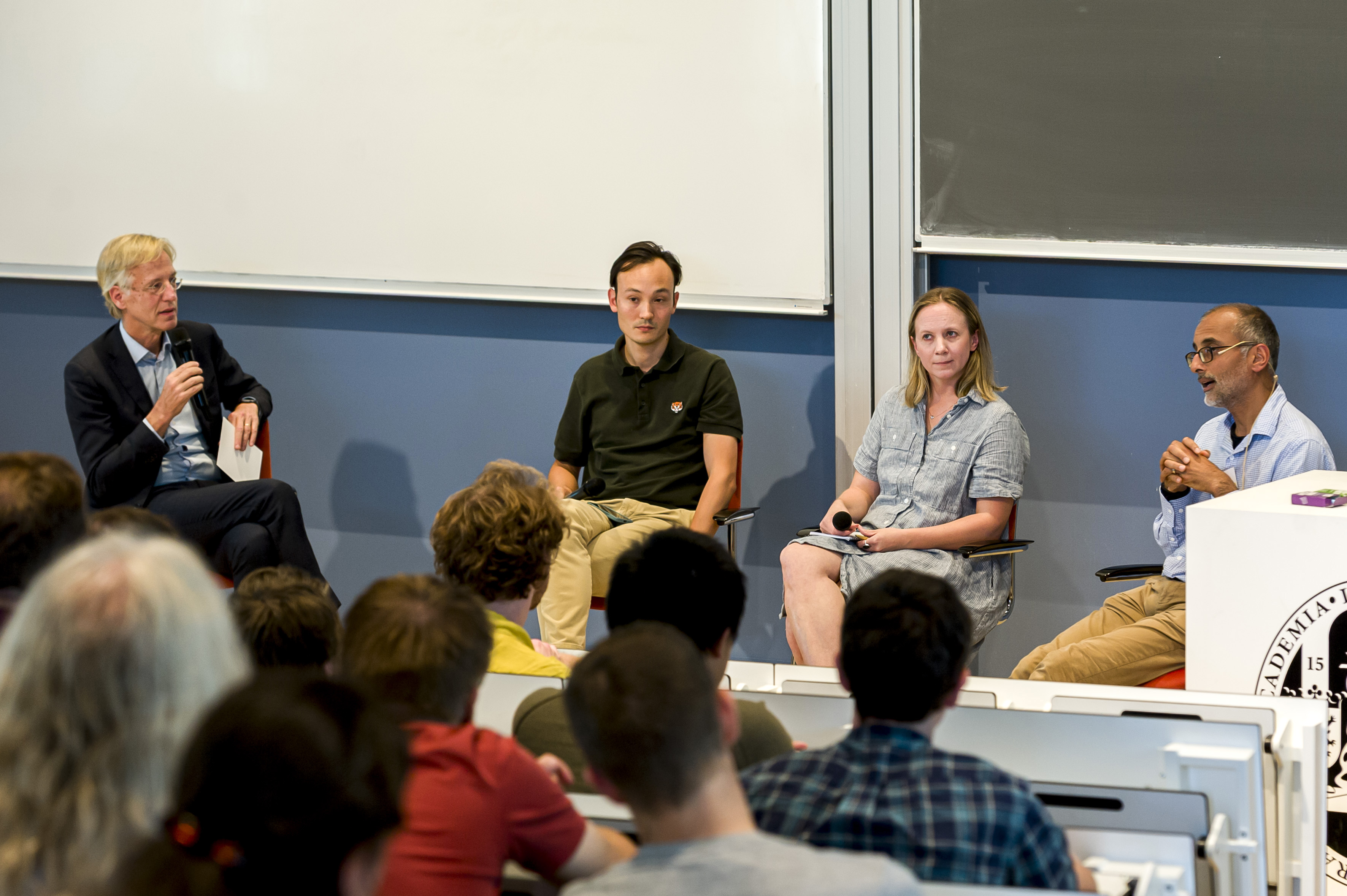
The idea for a declaration emerged during the NIAS-Lorentz Workshop on Mechanization and Mathematical Research in September 2025 in Leiden, which discussed the implications of rapid developments in technology for the practice of mathematics. The event brought together around sixty researchers from ten countries – including mathematicians, computer scientists, and scholars from the humanities and social sciences – and also included a public symposium.
The Leiden Declaration was written by a working group of sixteen participants from this group, convened by Jim Portegies of the Eindhoven University of Technology and in consultation with a wide range of members of the mathematical community.
The authors are Jarod Alper (University of Washington), Michael Barany (University of Edinburgh), Alain Chavarri Villarello (Vrije Universiteit Amsterdam), Sander Dahmen (Vrije Universiteit Amsterdam), Walter Dean (University of Warwick), Karthik Ganapathy (University of California, San Diego), Michael Harris (Columbia University), David Holmes (Leiden University), Mateja Jamnik (University of Cambridge), Steven Kelk (Maastricht University), Bryna Kra (Northwestern University), Ursula Martin (University of Oxford), Bartosz Naskręcki (Adam Mickiewicz University and Warsaw University of Technology), Rodrigo Ochigame (Leiden University), Jim Portegies (Eindhoven University of Technology), and Johannes Schmitt (ETH Zurich).