
Defending goals and borders: Wietse Jelles’ work for FC Utrecht and the Marechaussee
In the morning, Wietse Jelles can be found on the FC Utrecht training ground, working as Assistant Coach of the women’s team. In the afternoon, he advises the Royal Netherlands Marechaussee on border controls. Does his public administration degree prove useful in these two very different jobs?
Wietse arrives at the venue for our interview – the university’s Administration and Central Services department – wearing his FC Utrecht kit. He recently took up his new role as Assistant Coach in Utrecht. Together with the Head Coach, Sylvia Smit, a former professional footballer who played over 100 international matches for the Dutch national team, he’s preparing for the upcoming season.
The women’s team finished fifth in the Eredivisie league last season. ‘We have lots of new, young players and we’re currently developing a new squad and discussing our style of play’, he says. ‘I help analyse the opposition and devise the tactics.’
The benefits of his degree
That sounds quite far removed from his degree in Public Administration. Yet, he says, his degree does come in handy in the football world. ‘Preparing for a match involves a lot of analysis. I definitely honed my analytical skills – such as processing large amounts of information quickly and developing a strategy – during my degree.’
But, Wietse emphasises, just as important as his degree is what he did alongside it. Back in 2007, as a first-year student, he took part in the EL CID introduction week. There was one particular moment that really struck a chord with him. ‘In his welcome speech, the Rector at the time, Paul van der Heijden, emphasised strongly that you should involved in something alongside your studies. Join an association, for example. I joined the NSL student association and later became a board member. I also played football for LSVV’70 and became its chair.’
The start of his coaching career
He owes his current work in the football world to that role as chair. ‘During my year on the board, a group of female students came to the EL CID market and asked if we had women’s football. As the chair, I wanted to be inclusive, so I just bluffed and said we did, even though we didn’t have a women’s team at the time. They signed up, and that’s when I started coaching them. That marked the start of my career as a women’s team coach.’
And that’s what got the ball rolling – both literally and figuratively. Wietse took coaching courses and went on to become a coach at Ter Leede and Zeist, both top amateur women’s clubs. ‘I then became Head Coach of the under-16 girls’ team at FC Utrecht. Now I’ve moved to the first team, as Assistant Coach. I love this job because it brings together everything I’m passionate about: clear communication, motivating players and devising tactics.’
Ministry of Defence
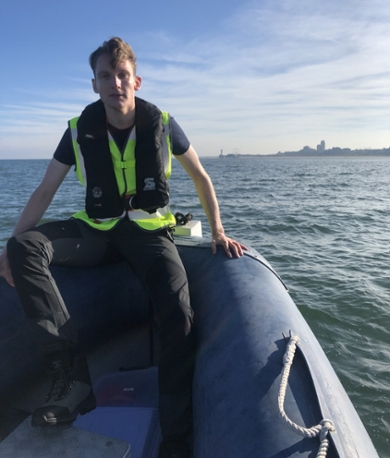
But then there’s a sharp transition to his other job at the Ministry of Defence, where he works as an adviser to the Royal Netherlands Marechaussee. How does he juggle the two jobs? ‘It’s certainly a busy working week. Officially, I work 24 hours at the Ministry of Defence and just over 30 hours at FC Utrecht. I act as the link between policy and implementation and advise on border controls and security. That involves visiting locations such as Schiphol and North Sea ports quite regularly.
‘In recent years, I’ve also been very involved in international collaboration. It’s a demanding job because there is so much tension across the world. My public administration degree and my academic skills – such as being able to critically evaluate information and understand the context that you’re operating in – have also been invaluable in this line of work.’
Ambitions for the future
How does Wietse see his future? ‘My ultimate ambition is to become a full-time women’s football coach. I can’t do that yet because I can’t make a living from it. In a few years’ time, I’d like to make the move to a Scandinavian or English women’s football club where that would be possible. My colleagues at the Ministry of Defence fully support my football work and share my enthusiasm for FC Utrecht.’
Female coach, male team
Lastly, a question about a hot topic at the moment: does he think a female coach could manage a men’s team? Could, for example, coach and former professional footballer Sarina Wiegman take over from the departing national team manager Ronald Koeman?
‘Yes, 100%! Unfortunately, the world of football is still quite conservative and there are still hardly any women at board level. In Germany, there was a female coach, Marie-Louise Eta, who managed a men’s team in the Bundesliga for a while. But why shouldn’t it be possible? I do enjoy coaching men too, by the way. In my experience, though, women are more likely to ask “why” and are more focused on the team as one unit. That suits me better.’
Advice to students
‘I don’t really believe in linear career paths. Many people only really find out what they’re good at as they go along. The same was true for me. I switched from history to a higher professional education programme and later to public administration. It was internships, administrative roles and part-time jobs that helped me discover what kind of work suits me. So, don’t be too hard on yourself. Don’t be afraid to change direction if you realise that a different path suits you better.’