
Interdisciplinary archaeological investigation uncovers gender- and age-selective violence 2,800 years ago
New research has revealed that one of Europe’s largest prehistoric mass graves records the deliberate killing of women and children, showing how gender- and age-selective violence was used to disrupt communities and assert power in the Early Iron Age. Leiden archaeologist Jason Laffoon was involved in this investigation.
Violent deaths
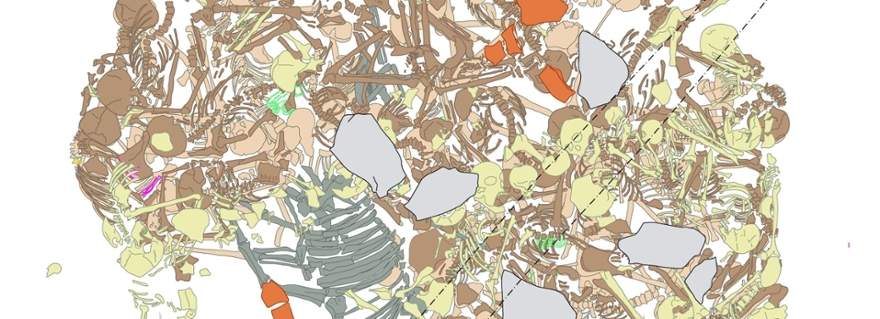
At the burial site of Gomolava in northern Serbia, the remains of more than 77 individuals were recovered—nearly all of them women or children. The victims, buried around 2,800 years ago, suffered violent deaths, including bludgeoning and stabbing. Genetic analysis shows very few of the victims were closely related, and isotopic data indicate many had grown up elsewhere and followed different diets.
Animal bones from the grave suggest some livestock had been brought from other regions. Despite the brutality, the dead were buried with care, including personal ornaments, pottery, and the remains of up to 100 animals. An intact calf was placed at the bottom of the pit, with burnt cereal grains and broken grinding stones on top, indicating a carefully staged and commemorated event rather than a hurried disposal.

Highly unusual
The demographic profile, dominated by women and children, is highly unusual in European prehistory.
The evidence points to targeted, symbolic attacks designed to unbalance power relations, claim land and resources, and fracture community continuity.
Dr Miren Iraeta Orbegozo, from the University of Copenhagen and one of the lead authors, notes: ‘By combining osteology, CT scans, carbon dating, and genetic and isotopic analyses, we could show not only how these people died, but also how communities lived and were transformed in the Early Iron Age.’
Innovative interdisciplinary research
Leiden archaeologist Dr Jason Laffoon was also involved in this investigation. ‘This study exemplifies the power of innovative interdisciplinary research to provide completely new insights on the complex dynamics of mass violence and public commemoration. The findings in this case have broader potential for improving our understanding of the diverse manifestations of structural violence not only in the archaeological record but also in the present day.’
‘Beyond documenting a single tragedy, our findings speak to human behaviour in times of upheaval. Systematically targeting women and children is a strategy aimed at breaking lineages and weakening community resilience,’ said Associate Professor Hannes Schroeder of the University of Copenhagen and senior author of the study.
Turbulent post-Bronze Age period
The massacre likely occurred during a turbulent post-Bronze Age period when communities were resettling landscapes, founding enclosed settlements, and reoccupying fortified sites. The killings likely formed part of systemic, large-scale conflict involving multiple groups across the region.