262 search results for “toilet superconductivity” in the Public website
-
Raindrops on the roof-technique reveals new quantum liquid
Koen Bastiaans and his colleagues discovered a new quantum liquid unlike anything ever seen. They did it by using a technique that can be compared to listening to the sound of raindrops falling on a roof. Publication in Science 29 October.
-
Rubicon grant for Remko Fermin: superconducting diodes for energy-efficient data centres
Physicist Remko Fermin from Leiden University was awarded a Rubicon grant from NWO. He will use it to study superconducting diodes that could contribute to reducing the CO2 emission of data centres.
-
Jan Aarts receives FOM Projectruimte Grant
Experimental physicist Jan Aarts has received a FOM Projectruimte grant of 545,000 euro. He will use the budget to study the interaction between superconducting currents and ferromagnetism. In the future, this might lead to computer memory with negligible energy consumption.
-
Nathaniel Martin in de Volkskrant about toilets in space
German scientists and NASA have developed a bacteria-killing coating for space toilets. With this coating they hope to protect astronauts in space stations from pathogens. Professor of Biological chemistry Nathaniel Martin sheds light on the discovery: 'You don't expect nasty bacteria up there, but…
-
Photon detection at subwavelength scales
Promotor: E.R. Eliel, Co-Promotor: M.J.A. de Dood
-
Strongly interacting electrons in Sachdev-Ye-Kitaev models and twisted bilayer graphene
In this thesis, we study systems of electrons in which strong correlations give rise to emergent exotic physics.
-
Pinching holes to create superconductors
In their quest for materials that conduct electricity without resistance at moderate temperatures, scientists usually work on their chemical make-up. Now Leiden physicists have come up with a radically new approach: pinching holes in a periodic pattern. Publication in SciPost.
-
Feeling safe at Humanities: an all-gender toilet in every building
The university is committed to providing an accessible learning and working environment for students and staff. They should be able to feel at home at our faculty. That is why there is now an all-gender toilet in every humanities building to contribute to that feeling of recognition and safety.
-
KHMW graduation prize for research on superconducting qubits
Matthias Flór receives the KHMW Graduation Prize in Theoretical Physics for his master's thesis. His research on exotic superconductors at Leiden University and TU Delft struck a chord with the jury. The jury unanimously chose to award Flór noting that ‘he demonstrated impressive technical abilities…
-
Quantum Matter and Optics
Research groups in the Quantum Matter & Optics programme investigate electronic properties of matter and light-matter interactions with emphasis on quantum information.
-
Record distance for alternative super current
Electrons that spin synchronously around their axis, turn out to stay superconducting across large distances within magnetic chromium dioxide. Electric current from these electrons can flip small magnets, and its superconducting version could form the basis for a hard drive without energy loss. Publication…
-
Collaboration group Aarts and Intel
Physics professor Jan Aarts starts a collaboration with chip manufacturer Intel to perform fundamental research in low-power, cryogenic computing.
-
Melting of frozen electrons visualized
For the first time, physicists have visualized the ‘melting’ of electrons inside a special class of insulators. It allows electrons to move freely and turns the insulator into a metal and possibly later into a superconductor. Publication in Nature Physics.
-
Lorentz Lecture: Superconductivity
Lecture
-
Solution to distortion effect STM scanning
STM scanning experiments on poorly conducting materials are challenging, and can cause a distortion effect. A new model corrects for this effect, allowing physicists to better study materials in their quest to understand unconventional superconductivity. Publication in Physical Review B as Editor’s…
-
Frost for sale!
Liquid nitrogen, frozen fruit and levitating market-goers. On Friday 8 April, visitors to the weekly market in the Merenwijk district were exposed to superconductivity. What is it exactly? And what does it look like? Young and old were impressed by the experiments demonstrated by Leiden students from…
-
Three FOM-Projectruimte Grants for Leiden Physics
The Leiden Institute of Physics has been awarded three out of twelve available grants from the FOM Projectruimte. Principal Investigators Milan Allan, Stefan Semrau and Carlo Beenakker all receive around 400,000 euro for their research.
-
Spinoza prize for Jan Zaanen
Jan Zaanen, Professor in Theoretical Physics of condensed material, has been awarded a Spinoza prize. His pioneering ideas about the collective behaviour of quantum particles and high temperature superconductivity have often given him the reputation of being something of a rebel.
-
Surprising similarity between stripy black holes and high-temperature superconductors
We don’t understand how some materials become superconducting at relatively high temperatures. Leiden physicists have now found a surprising connection with auxiliary black holes. It enables us to use our knowledge of black holes on the mystery of high-temperature superconductivity. Publication in Nature…
-
Three awarded research projects in NWO-XS call
Cryogenic memories, antibiotic treatment for urinary tract infections and recycling plastic sustainably. These are the subjects of the three NWO-XS grants awarded to Leiden Science researchers.
-
Michiel de Dood Lab - Quantum Detection
Our group explores the larger domain of quantum measurement. In particular we investigate two themes that are closely connected: The detection of specially prepared quantum states of light and understanding and characterizing quantum photon detectors.
-
Physical reality of string theory demonstrated
String theory has come under fire in recent years. Promises have been made that have not been lived up to. Leiden theoretical physicists have now for the first time used string theory to describe a physical phenomenon. Their discovery has been reported this week in 'Science'.
-
Smoothly breaking unitarity : studying spontaneous collapse using two entangled, tuneable, coherent amplifiers
The Copenhagen interpretation of quantum mechanics states that a measurement collapses a wavefunction onto an eigenstate of the corresponding measurement operator.
-
Leiden discoveries
From the Big Bang to superconductivity. Many ground-breaking discoveries have been made in Leiden University’s long history.
-
The Lead Zeppelin
As an alternative to the diving board shaped force sensor, we are now developing a magnetically levitated small superconducting particle – or ‘Lead Zeppelin'' – as our mechanical resonator. We explore routes towards detection of gravity between small objects.
-
 Van Steenis
Einsteinweg 2, Leiden
-
 Academy Building
Rapenburg 73, Leiden
-
 Sylvius
Sylviusweg 72, Leiden
-
 Tom van der Reep
Faculty of Science
-
Growth and Transport properties of (Rare Earth)TiO3 / SrTiO3 interfaces
This thesis presents the results of a study on the interfaces of insulating oxides with and without the insertion of a magnetic layer.
-
Setup: Static Magnetic Field with Low Noise
Our cantilevers have a low intrinsic damping rate: this enables us to measure with low noise, since damping is proportionate to noise. However, when the magnet is close to the surface of a sample we want to study, we measure a much higher effective damping rate. This is caused by magnetic interaction…
-
Towards Superconducting Spintronics with RuO2 and CrO2 nanowires
PhD defence
-
Water
Leiden University is committed to reducing our water consumption.
-
 Oude UB
Rapenburg 70, Leiden
-
 Willem Einthoven
Kolffpad 1, Leiden
-
Understanding Single Photon Detectors
Leiden physicists have developed a way to address how accurately a superconducting single photon detector (SSPD) can be characterized by detector tomography. SSPDs are not fully understood, and tomography is a key element to determine how these devices detect light. A better understanding of these detectors…
-
Research
Physicists at the Leiden Institute of Physics (LION) conduct fundamental research into physical phenomena. They are inspired by curiosity and the desire to know more about the world in which we live. This research has always paved the way for new practical applications. These are something that the…
-
Setup: MRFM
MRFM combines the principles of magnetic resonance and atomic force microscopy.
-
 Arsenaal
Arsenaalstraat 1, Leiden
-
 Old Observatory
Sterrenwachtlaan 11, Leiden
-
Quantum Emitters
We study the dynamics of individual emitters in micro cavities.
-
Hybrid Josephson junctions and their qubit applications
A Josephson junction is a device where a thin insulating barrier or a nanostructure is placed between two superconducting leads. Such a junction is essential to superconducting qubits that store quantum information due to its anharmonic spectrum.
-
On the random-matrix theory of Majorana fermions in topological superconductors
The thesis mainly contributes to the characterization of Majorana fermions as they appear in the Condensed Matter context.
-
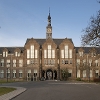 Poortgebouw
Rijnsburgerweg 10, Leiden
-
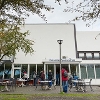 University Sports Centre
Einsteinweg 6, Leiden
-
 Snellius
Niels Bohrweg 1, Leiden
-
 Gorlaeus Building
Einsteinweg 55, Leiden
-
Black holes with ‘dreadlocks’ offer insight into quantum matter
Physicists understand little about quantum matter, which is a building block of future quantum computers. Theorists have now discovered that black holes with ‘dreadlocks’ harbor a similarly exotic order pattern, which makes calculations on quantum matter easier. Publication in Physical Review Letter…
-
 Oort
OortNiels Bohrweg 2, Leiden
-
Physicist Sense Jan van der Molen plays ‘Dutch shuffleboard’ with electrons
Physicist Sense Jan van der Molen researches materials that do not exist in nature. ‘It’s fascinating to see how the properties of a material change if we manage to make it super thin.’ He will give his inaugural lecture on 21 October.