‘As long as the logic works, you can do whatever you want’
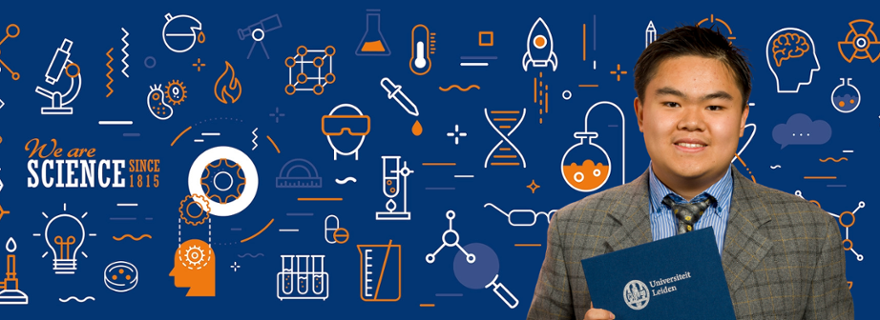
With a healthy dose of logic and creativity, mathematics student Lance Bakker shows how computers can prove complex mathematics. His method proves intricate formulas without calculating every intermediate step. It earned him a nomination for the Leiden Science Young Talent Award 2025.
How did you chose your field of study?
‘I enjoy my studies so much that it hardly feels like work. As long as the logic works, you can do whatever you want. I first experienced that freedom at the Mathematics Olympiad at high school. Solving those problems was far more satisfying than completing a regular puzzle book. I also met other young mathematicians there, whom I still speak to every day. Attracted by this combination of logic and creativity, I decided to study mathematics.’
How did you come up with your thesis topic?
‘I was immediately drawn to the proposal presented by my supervisor, Emre Sertöz. It followed a philosophy in geometry that was even new to my Olympiad trainers. The project works with a variable system, which is a system where some parts are still open or unknown. You examine a few instances of the system—specific examples where you fill in values for the variables. Those few examples are enough to prove a statement about the whole system. In other words: “If it’s true often enough, it’s true for the whole system!” Throughout my thesis, I kept using this mathematical way of thinking, almost like looking at the problems through a special lens.’
What did you research and what did you discover?
‘Everyone remembers struggling at school with proving theorems using sine and cosine. Nowadays, a computer can do that automatically. My thesis shows how to make this happen. Some formulas, however, are still too ‘wild’; they are so complex that the computer needs much longer than expected to calculate them.
I discovered my own contribution by chance. For another homework assignment, I had to prove a formula myself. That’s when I noticed the parallel with Olympiad geometry. Just like then, I realised you don’t always need to calculate every step; with clever insights, you can sometimes skip the most complicated parts!’
‘My approach required the dedication of an artist’
What moment or lesson from your thesis stands out the most?
‘The most memorable moment was when I truly understood my method and had to develop it further. Emre even called it a kind of phase transition: I went through the literature, formed conjectures and proved results.
That’s when I really experienced what it’s like to be a mathematics researcher, and what the work involves beyond the maths itself. Emre showed me how much happens behind the scenes—not only in articles and presentations, but also in half-formed ideas and spontaneous brainstorming sessions. He said this approach requires the dedication of an artist. That image stuck with me and confirmed just how closely mathematics connects to art and culture.’
What are your plans for the future?
‘Luckily, as the Young Talent Award reminds me, I’m still young. There’s so much mathematics left to discover and explore. I’ve always chosen my own path, from my school years up to studying here in Leiden. I’ll continue to do that as I take the next step as a researcher: looking for a PhD position that really suits me.’