Sea-ing Africa: Five students looking back on their experience
What is it like to do your master’s research with Sea-ing Africa? Five students who recently completed the programme, with fieldwork in Morocco and Ghana, share their experiences in their own words. They talk about how they found their topics, what months of independent fieldwork felt like, how the field school prepared them, and the collaborations and friendships along the way. This is a demanding programme, but one the students look back on with pride and enthusiasm.
Branching In and Out of Sea-ing Africa Themes
Sea-ing Africa takes big infrastructure projects such as ports, railways, roads, bridges in the port city regions of Ghana and Morocco as a lens for understanding societal transformation. The students describe how their own research grew into, and out of, these themes of infrastructure, sea and land, heritage and temporality.
Lotte
Student

“Out of all the internships, I felt like the Sea-ing Africa project was a great opportunity to go abroad, work with different disciplines, people, and just an incredible opportunity [...] to learn new things, be in a totally different context. And I felt that I could also add a gender perspective to infrastructure.”
“You get the freedom to research what you want to research, but within [...] a framework, so you have the support and the help and the guidance [...] and you're not fully doing it alone and you're part of something bigger.”
Tiziri
Student

“There was not a set topic or set structure that you had to uphold. So I could [...] create a thesis that was aligned to my interests, but also would fit in the broader context of Sea-ing Africa. I took these topics like heritage, infrastructure, these methodologies like mapping, and then I adapted them to my own research topic.”
Valentine
Student
“Even though infrastructures have this idea [of] a better future, for a brighter future, at the same time there’s... stalled ambition, projects get stalled. There’s a lot of political influences and social influences that hinder these projects to be finished. And I look into how these impact women’s lives who are engineers either working closely with these projects or not even working with these projects but still are impacted by it. So, I think that’s where the biggest connection between my thesis, my research, and Sea-ing Africa is; this temporality of infrastructure, how [women] navigate life within that. [Gender] was not a part of the Sea-ing Africa project, but that’s the main theme of my research. But through gender I got to also see so many aspects of the Sea-ing Africa research.”
A Peak at Five Different Research Projects
Five students, five very different projects: tourism and the commodification of heritage in a town in northern Morocco, belonging among Dutch Moroccans in Tangier, women navigating engineering in Sekondi-Takoradi, everyday life alongside the Ankobra Bridge, and market women coping with a suspended redevelopment in Sekondi-Takoradi. Each found their own angle within the shared Sea-ing Africa framework.
Tiziri 🔎
Tourism and Heritage in a Town in Northern Morocco

“Broadly speaking, [my research] is about kind of the tourism driven commodification of heritage spaces. [My] research was ethnographic. So my methodology consisted of ethnographic mapping, where I kind of recognised the financial investments in this town to focus on the economic lives of residents. I also did participant observations, specifically in the Medina, which is the city centre of this town […] And I also did interviews, a series of interviews at the municipality.”
Kenza 🔎
Belonging and Home Among Dutch Moroccans in Tangier, Morocco
“I did research in Tangier in Morocco […] and I looked at Dutch Moroccans that have moved from the Netherlands to Tangier […] and I was mainly interested in how they negotiate feelings of belonging and home there once they’ve moved there.”
“Mobility is sort of a condition for belonging and being in constant motion allows for belonging to be formed and migration is not an end point in which home is found, but the home is created through constant movement between places.”
Valentine 🔎
Women in Engineering in Sekondi-Takoradi, Ghana
“I ended up doing research about female engineers and female aspiring engineers and how they navigate […] the social and material landscape of Ghana.”
“I went around the city and literally just knocked on a bunch of engineering firms to be like, hey, do you have any female engineers working here? And then I found a secretary, an apprentice, someone who just started and a project manager as well. […] So it was very much women in all different phases of life”
Zaby 🔎
Living with the Ankobra Bridge in Ghana
“[The Ankobra Bridge is] a bridge that is part of a larger highway that is part of a larger corridor that goes across several African nations, but it’s alongside the coast.”
“How do people live with a bridge? How do the politics that come with this bridge, so for example, the narratives [about rebuilding] that they’re hearing […] affect their daily lives and their future aspirations?”
“I learned very quickly that some women, they are at the bridge every day from morning to evening and they sell food to passengers [in cars]. So they use the bridge as a nice opportunity to enhance their life”
“There is a big bridge and there is a dream [of a rebuilt modern bridge] and there is politics who are involved in the development of these infrastructures, but then there is a village that lacks such basic infrastructure. So the contrast between this was important.”
Lotte 🔎
Market Women and the Suspended Redevelopment of the Market Circle in Sekondi-Takoradi, Ghana
“My research was about how [...] the suspension of [the redevelopment] of the market circle [...] impacted the everyday lives of the market women.”
“The market got decentralised, in a spatial way. So traders were selling in different places. And this caused a big loss of business for the women because there's less foot traffic. [...] They also experience like a lot of waiting and unhappiness with where they are now, because they were supposed to wait two years, but now they're waiting five years.”

“Traditionally in African markets and in Ghana, there is this power structure in markets. So you have the queen mothers and they are the market leaders. But now [...] they got relocated to this new market and there are issues in this market and there were some traders that felt like the market queen mothers were not doing enough about the issues. So they started their own group and decided to take actions into their own hands and organise protests and have connections with authorities to advocate for themselves and their rights. And so there's this kind of new leadership in the market. So the redevelopment also had a political consequence, not only economical or social or spatial.”
Personal Experiences of Doing Research in the Field
Three months of independent fieldwork is intense: exciting, sometimes lonely, and full of personal growth. Far from home, students had to approach strangers, build trust, and find their way in unfamiliar languages and places. They speak candidly about both sides: the moments of doubt, and the confidence, connections and self-knowledge they brought back.
Lotte 🔎
“Beforehand, you really don't know where you're going or what it's actually like to be there. [...] the only way to experience or to know is [...] to do it and to be there, and it's very hard to explain to other people. [...] it's just extra knowledge about how the world works and how different people live and [...] that teaches you something about life yourself.”
“I made [...] a great connection with one woman who was [...] one of the informal market leaders. And so I spent a lot of time with her and in her shop. And she [...] sort of like adopted me as her daughter from the first moment that I met her. [...] It was really cool to build that relationship and to really get a deep and close personal look into her life and her [...] days in the markets and [...] she showed me around the city and I went with her to church and everything. [...] She really helped me with my research. She was like my key informant. So that's [...] a really cool connection that I made.”
Zaby 🔎
“You also develop yourself personally in the field. Suddenly you have nobody to rely on, [no one] you really know. So you also get to know yourself in a totally different way. And you also come back as a different person, even though [the research phase] was not that long.”
Kenza 🔎
“I really had to push myself to approach people and to […] ask someone if they’re willing to participate in [my] research. So, it took me a bit of time to get into that flow of really consistently asking people for things.”
“Once you’ve done it […] a few times and every time it has worked out and it has brought you even more than you maybe thought it would, or it leads you to new opportunities you didn’t even think about, then that’s also motivation for doing it again the next time.”
Tiziri 🔎
“I was in a host family with another person and [due to language barriers] I was the only person capable of somewhat communicating with my host family. So I think mentally that was a challenge for me. It was something that really also challenged me and I think was also kind of helpful in the end because when I then went to my research sites, it kind of had already brought me into that space of not easily being able to communicate with people.”
Valentine 🔎
“It was a very difficult experience. But do I think I would do it again and other people should do it? Yes!”
The Field School Experience
Before starting their own fieldwork, students take part in a field school together with students and professors from the partner universities. Its location alternates: Tiziri and Zaby attended the field school in Rabat, Morocco (hosted at NIMAR, the Netherlands Institute in Morocco); Kenza, Valentine, and Lotte attended the field school in Ghana (hosted at UMaT, the University of Mines and Technology, School of Railways and Infrastructure Development, Essikado Campus).
Zaby 🔎
“The field school [...] was so interesting because [...] every day we had some kind of workshops, lectures, but then also we got tasks to do. So we had to go to the field and to research something with a group and then come back and then make a presentation.”
Valentine 🔎
“The interdisciplinary aspect was a big part of it. […] But also intercultural aspects of just working in a small group of people where you’re coming from different academic backgrounds, different cultural backgrounds, and you need to learn how to navigate all of that to produce your assignments. That taught me a lot.”
Tiziri 🔎
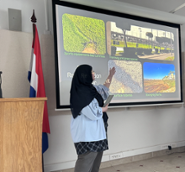
“Sea-ing Africa provided me with a host family when I was in Rabat. We had these workshops where they taught us different methodologies. We had these outings that were continuously connected to our own research topics. […] I feel like they really connected the workshops to our own research.”
Lotte 🔎
“I think it was a really good experience and it definitely helped me in my research because [the field school] specifically touched upon my topic. And it's also an overall nice experience to [...] meet other people and have new perspectives on your research or on what they are doing or how they experience things. [...] it was also a nice way to see more of the [...] place that we were in and to understand the context of the research that we were doing.”
What the Programme Contributed
From weekly seminars in Leiden to supervision, contacts and confidence in the field. This is what the students say Sea-ing Africa added to their research and their broader learning journey. Beyond methods and feedback, they describe a network of people to fall back on, perspectives from other disciplines, and practical experience to carry into their future careers.
Tiziri 🔎
“Through Sea-ing Africa, I could see different ways of doing research and different kind of collaborations that could occur across fields because not necessarily everyone in the room was an anthropologist.”
“You had someone who was specialised in infrastructure, another was in geography.”
“[Sea-ing Africa] is really about supporting the people with their research, but also allowing them to get new insights that can then also be incorporated in their own research. […] I really was pleased with my experience.”
Kenza 🔎
“I think for me what was important were the lectures we had before going [abroad]. Every Monday evening we had a lecture from a different [professional].”
“One lecturer really inspired me to also take a step back and look at [my research] from the point of view of a map and to see where are these places that are important located and what does that tell me about the people that I am studying.”
“It felt like there was support, not only from my supervisor, but from this whole group of Sea-ing Africa people.”
“There are people that are in working on [the] country as well on a topic that is related [to mine, who] you can ask for advice. So you’re not doing this whole new thing all on your own”
“The Sea-ing Africa project has really helped show me that that you can have one topic, but there’s a lot of different ways to look at it […] city planning and spatial design [...] and how that can be very relevant and such an interesting way to look at things.”
Zaby 🔎
“I think the seminars in Morocco gave me more confidence, especially because I was meeting other people with other backgrounds as well. So it made me more curious. We tried things in the field, we were together so we could help each other out. There were people covering your back.”
Lotte 🔎
“I do want to maybe end up in or working for an NGO or a human rights organisation or something like that. So this is a very [...] practical experience with conducting research and being able to do it in a totally different context and to know that piece of the world. So I think it's definitely [...] something that is going to help me in the future and in whatever job I'm going to end up in.”
Interactions and Collaboration with Students from the Netherlands, Morocco, and Ghana
The field school brings together anthropology and African studies students from Leiden, architecture students from Delft and Rabat, engineering, African studies and history students from Sekondi-Takoradi, Tarkwa and Accra, and professors from Institutes in the Netherlands, Ghana and Morocco. This is how the student experienced this:
Tiziri
Student
“On a more casual note, we were just being friends. We were, you know, going out in the city. We hung out together, joked together, sat together, things like that. But also it was interesting to know, like, how they were being taught and how we were being taught.”
“There was a group of architects in Morocco that were really close to the program. They were also architect students that were then doing Sea-ing Africa and their way of thinking and their way of […] thinking with anthropologists was really inspiring. So those are contacts that I could potentially also reactivate.”
Zaby
Student
“The way how we look at things. It’s so different. And then you start to talk about it. And it’s really nice to learn from each other. I really, really saw the benefit of the collaboration between anthropologists and architectures.”
Valentine
Student
“The people that I was with, we had the same outlook and we had the same idea and we had similar values and everything. […] I’m super glad that we, you know, we’re really there for each other. They helped me so much, and I’m sure I helped them too.”
To Whom do Previous Students Suggest Sea-ing Africa
Asked what they would tell the next group of Sea-ing Africa students, this is what they said. They do not sugar-coat it: fieldwork is intense, and there will be weeks when you feel stuck or out of your depth. But their advice—know yourself, take breaks, stay open to new people— comes with a clear message: if you are up for the challenge, do it.
Kenza 🔎
“If you’re thinking about doing research in Morocco or Ghana, then this [programme] is very helpful [in] guiding your research and also to bring you new perspectives.”
Zaby 🔎
“There will be moments, [...] it can even be like a week or two weeks that you think you are stuck. Give yourself a break and don’t try and push. [...] Just take a break. For example, go to another place, go travel a little bit or just be nice to yourself.”
“When I took the break and I relaxed and I started to feel good within myself, suddenly something clicked and I realised something. And that became the most important thing in my research, actually.”
Valentine 🔎
“You can […] find comfort in the unknown. It’s just [that] you need to find what fits you the best.”
Lotte 🔎
“You have to be [...] ready for a challenge. [...] And be open for new connections and new people.”
“Really think about who you are and what you're comfortable with, and [...] plan or design your research around that. [...] It's going to be intense. But if you're up for it, totally do it. It's an amazing experience. You're going to learn a lot.”
Interviews conducted and edited by Finn Bergmann.